Howard Dean Speech Set to Hip Hop Beats

Howard Dean, Hip-Hop Star
Fri Jan 23, 4:35 PM ET Add Entertainment – E! Online to My Yahoo!

By Joal Ryan

howard-deanHoward Dean (news – web sites)’s gaffe was Jonathan Barlow’s muse.

When Dean, the Democratic presidential hopeful, rolled up his shirt sleeves, rattled off the names of the 50 states and unleashed a throaty howl after going down to defeat Monday night in the Iowa caucuses, Barlow, the St. Louis graduate student, said he just knew: “I had to do something.”

And so Barlow put Dean’s much-mocked tirade to a hip-hop beat with horns and upright bass, and an Internet star was born.

Since he posted the 15-second clip on his blog at BarlowFarms.com on Tuesday afternoon, Barlow’s tripped-out Dean rant, dubbed the “I have a scream” speech, has been snapped up by media outlets from MSNBC to VH1, and likely blared from a computer speaker near you.

It’s not the only Dean rap out there–Right magazine’s online offering, “Dean Goes Nuts Remix,” proved so popular, the publication took it down because of traffic concerns.

“I think everyone of my generation…who saw the speech, whether they’re a Dean supporter or not, thought it was hilarious,” the 29-year-old Barlow said Friday.

Barlow said his remix was inspired by the work of comedian Robert Smigel, whose “TV Funhouse” contributions to Saturday Night Live have long used actual audio clips with which to hang the mighty and oft-quoted.

It also follows in the fine political-slash-Internet tradition of, say, editing together Ronald Reagan speeches until it sounds as if the former president and the “Just Say No” first lady Nancy Reagan are bemoaning a national marijuana shortage, and copping to heroin addiction.

“Anybody can do this in your basement,” Barlow said.

The religious history scholar’s own efforts were assisted by the Drudge Report, which posted the raw audio of Dean’s raw growl, headlined “YAAAAAAAAAAAAAARRRRHHHHHH!!!!!!!!!’,” on Tuesday morning. It’s that clip that Barlow funkified.

“I wanted it to be fast and funny and energetic,” Barlow said. “…I thought my small group of friends would think it’s funny.”

Barlow’s small group of friends proved so vast, and overall criticism of Dean’s lack-of-concession speech so great, that by Thursday night, the former Vermont governor was on CBS’ Late Show with David Letterman in damage-control mode, offering up a Top 10 list on “Ways I, Howard Dean, Can Turn Things Around.” (Number one: “Oh, I don’t know–maybe fewer crazy, red-faced rants?”)

Barlow, for one, said he wasn’t out to get Dean, the onetime Democratic frontrunner. Then again, he wasn’t looking to vote for him either.

Said Barlow: “I’m a supporter of George W. Bush.”

No doubt there’s a song somewhere in there, too.

http://www.youtube.com/watch?v=jBGR2I6pFYk

Playahata newsletter: Rakim Injured in Car Crash

Rakim

Rakim

Originally Ooh Papi was going to do a newsletter for today but yesterday his fiancee forced him to watch American Idol with her and that threw off his schedule. He said he would start compiling the newsletter after he saw a heterosexual black male contestant and that explains why you don’t have a newsletter today. 🙂

RAKIM INJURED IN CAR CRASH

Anyway the greatest rapper of all time was injured in a car accident yesterday leaving my great state. Yes, Rakim was injured in a car accident leaving Connecticut for New York but he is expected to fully recover although he is still hospitalized.

In addition one of the greatest singers ever (imho) also had a sad day yesterday Arne Naess Jr., the Norwegian shipping magnate & former husband of Diana Ross who fell to his death on January 13th while climbing in the mountains near Cape Town, South Africa, was laid to rest at a private memorial service in Norway on Wednesday (January 21st). Only close friends and family attended the service, which was performed in English out of respect to Naess’ foreign family members, including his ex-wives Diana Ross and Filippa Kumlin; his partner at the time of his death.Mr. Naess was climbing in the Groot Drakenstein mountains, about 44 miles outside of Cape Town, when he apparently slipped and fell more than 300 feet to his death. Mr. Naess did not have much protective gear, just ropes and a harness. Mr. Naess was an experienced mountaineer who led a team of Norwegian climbers to the summit of Mount Everest in April 1985. He and Ross had two sons before their divorce in 1999.

It seems like I have so much bad news these days, so let me tell you something lighter. Sen. Hillary Clinton (D-N.Y.) found Bush’s speech laughable in its own right. Viewers spotted her snickering when Bush called for a curb on athletes’ use of performance-enhancing drugs.
“Now if he had mentioned testosterone, that would have been funny,” Clinton told colleagues after the speech. She perfected her line later when she told reporters Bush’s address was “partisanship on steroids.”I thought that bit about steroids in baseball was the most misplaced rhetoric ever in a State of the Union Address. We all have ‘beaten-wife syndrome,’ where we’ve been lied to so often,” “George Bush is like a drunken, unfaithful spouse who’s gone out and cheated on us so many times that at this point we just “accept it”….He looks like the belligerent guy in the bar who tries to pick a fight with you .

The Latin sensation from D.C. did about 18 newsletter rants last year but on his special day, let’s take a look at what is listed under the Boricuan sensation’s columns, although it isn’t all his.This Washington, D.C. family man has had 10 excerpted items from his column highlighted on his day. I bet you don’t know why Playahata.com has made this Ooh Papi day ? -Charlie the Moderator

==============================================

1.It’s Getting Sweaty In Here -“Meanwhile, Rocawear never addresses the sweatshop issue but Ironically, Latin America’s greatest martyred freedom fighter Che Guvera has become a symbol of Rockafella’s co-founder and greatest artist Jay-Z A.K.A., Sean Carter. Nobody cares that Che Guvera was anti-Rockefeller (the man that the label was partially named after). In the end I think Che summed it up best some years ago, when he said “The amount of poverty and suffering required for the emergence of a Rockefeller, and the amount of depravity that the accumulation of a fortune of such magnitude entails, are left out of the picture, and it is not always possible to make the people in general see this. ”

2.An Open Letter to the Hip-Hop Summit Action Network(HSAN) -“Benzino is shady, he himself was once affiliated with a white emcee, and that white emcee used the N word on the track they made together. In fact, it appears that Benzino told his white emcee to use the N word.The emcee in question is named Bawston Strangla, and his connection to Benzino is detailed on artists.iuma.com/IUMA/Ban…Strangla/, where you can also download the song he and Benzino worked on together in 2000, “Shamrocks and Glocks”. About 35 seconds into the song you will hear Strangla drop the proverbial “N” bomb, in a passage that sounds very random and out of place alongside his other lyrics.The website hiphopmusic.com contacted the white emcee and he said Benzino told him to use the N word.(yes you read right) This does nothing to minimize the offensiveness of Eminem’s track and lack of response by Em but “it does places Benzino’s righteous indignation in a different light. Just in case anyone was starting to take him seriously they should rethink that and the same goes for HSAN and their political posturing.

3.Real Playboy Pimps ride The Hip Hop Hummer to Bank -“The Hip-hop generation is mislead because many of the high profile rap artist who get media attention are uninformed or make associations based solely on their personal interest. Hollywood has many of them caught up in its surreal Matrix and since rap (the biggest component of hip hop) is totally crossover now the business ties and interests of people like Donald Trump and Arnold Schwarzenegger are the same as those of people like P-Diddy or Russell Simmons. That is a conflict of interest for the African-American community as well as any working class community, black, white or other. Donald Trump once considered running for political office and could win just as Arnold did. While both Trump and Arnold have a history of indifference or outright prejudice to communities of color it won’t make a difference at the ballot box to communities of color. Unfortunately, the rich playboy image is being swallowed by too many voters. It makes no difference to voters that the rich elite ONLY see them as a market waiting to be exploited.”

4.Rush Limbaugh Finally Skinned by Tabloid Media – Listen people (something the partially deaf Limbaugh can’t always do). Limbaugh got the job because he committed those zany and intolerant acts. The real issue is that it is part of the norm for unqualified whites like Limbaugh to get high paying, high profile jobs even if the resume does not support such a hire. The dismissal of the Redskin name change lawsuit by the judge and the hire of Limbaugh the bigot are proof that racial bias and neglect are not real concerns in the NFL.

5.’Making Da Band’ was Making The Exploitation of Us.- MTV showed what probably added up to a whole season of ‘Making Da Band 2’ this weekend. I saw about 10 episodes and all I can say is that somebody should call the department of Child Welfare on both MTV and P-Diddy. That was the most exploitive “reality show” I ever saw. Come to think of it those were young adults not children, so don’t call Child Welfare. I guess, I am thinking child because the one named Frederick still sucks his thumb like an infant.

6.Tommy Hillfigger Vs Beanie Sigel -A Look at the Urban Hoax – Joel J. Horowitz, Tommy Hillfigger’s chief executive says that the denim business is now dominated by urban brands who have become successful in using their own logos. He says Tommy, “needs to be more fashion-right with the denim details that we put forth through fabric or sophisticated washes, and compete more on the product side versus the logo side.” So Tommy took Horowitz’s advice, his new approach. A billboard above the West Side Highway in Manhattan featuring what a competitor described as “Pacific Sunwear meets Ralph Lauren meets `From Here to Eternity’,'” Analysts and others in the retail industry have wondered why he has switched his game so dramatically. It’s simple the hood got no more love for Tommy and his cash register is hurting.

7.Deadly Makeovers -I was amazed at all the positive coverage mobster John Gotti received when he died. A lot of it was untrue. The press for the most part did this makeover of him as a good man. He was a mobster for Christ sake, you know what they do.

8.The Real Murder Inc. …. Don’t Laugh- “So, when Bush is envisioning “a foreign-handed foreign policy,” or observes on some point that “it’s not the way that America is all about,” Miller contends it’s because he can’t keep his focus on things that mean nothing to him. “When he tries to talk about what this country stands for, or about democracy, he can’t do it,” he said. This, then, is why he’s so closely watched by his handlers, Miller says – not because he’ll say something stupid, but because he’ll overindulge in language of violence and punishment at which he excels. “He’s a very angry guy, a hostile guy. He’s much like Nixon. So they’re very, very careful to choreograph every move he makes. They don’t want him anywhere near protestors, because he would lose his temper.”

9.Artists Don’t Make Money From Record Deals -“So the artists actually receive $19,333 each for their gold album, and in two years when the reserves are liquidated, IF they’ve recouped, they will each receive another $63,000. IF they’ve recouped. Guess who keeps track of all of this accounting? The label. Most contracts are “cross-collateralized,” which means if the artist does not recoup on the first album, the money will be paid back out of the second album. Also, if the money is not recouped on the second album, repayment can come out of the “in reserve” funds from the first album, if the funds have not already been liquidated”

9.I am not down with this war @#%$! (Will the real Slim Cheyney please stand up) – Moreover, documents uncovered by the Center for Public Integrity show that Halliburton received $1.5 billion in government loans and loan guarantees during the five years Cheney was CEO. That compares with just $100 million during the previous five years…….”He’s receiving money from the government and money from a private-sector company with government contracts,” said Allison. “Whose payroll is he on?” The answer: Both of them. And that couldn’t be right.


The Source Magazine, Eminem, Hip Hop and Race

Here’s an interesting article dealing w/ growing skepticism of the Source magazine, Hip Hop and Race..

Eminem

Eminem

It was a press conference called by a high-profile congresswoman, the founder of a magazine once considered “the Bible of hip-hop” and a respected Los Angeles community activist. The goal: to tackle issues of racism in the music industry and to announce a plan “to reclaim ownership of hip-hop for the African American community.”

On the podium in Beverly Hills on Friday were Rep. Maxine Waters (D-Los Angeles), Source magazine founder David Mays and activist Aqueela Sherills, who helped broker a 1992 truce between rival gangs in Watts. Presidential candidate the Rev. Al Sharpton even put in a surprise appearance.

The participants decried what they characterized as a deliberate effort by the music industry “to redefine and repackage hip-hop for mainstream America” and outlined plans for a national peace campaign with a series of hip-hop festivals aimed at reinfusing money generated by rap music back into communities where it was born.

But there was also an elephant in the room, one that all on hand did their best to ignore: the ongoing feud between the Source and the world’s most popular rapper, Eminem, who is white.

Following a presentation that ran more than an hour, Mays, who is also white, called for questions from the press, but the Q&A session wrapped in less than five minutes. There were barely half a dozen reporters in the 150-seat ballroom.

The light turnout appeared to reflect increasing media skepticism toward the Source since the publication launched a series of attacks last year against Eminem.

Just as the magazine has assailed his character and integrity in the world of hip-hop, the mainstream press has been asking the same things about the Source. In its Jan. 12 issue, Time magazine writes that “outrage has boomeranged on the questionable journalistic judgment of Mays and the Source.”

The public skirmish began in the Source’s February 2003 issue, which included an article critical of Eminem and an illustration of rapper Benzino holding the Detroit rapper’s severed head. Benzino, whose real name is Raymond Scott, is Mays’ business partner.

The attacks escalate in the Source’s February issue, which hit stands last week — with Eminem on the cover. Several articles again paint him as a racist and a culture thief, a white kid who has profited enormously, and unfairly, from an art form created by blacks.

The magazine comes with a CD containing excerpts of a tape Eminem made at least a decade ago in which he denigrated black women.

The Source, which made the tape public in November, argues that the comments refute Eminem’s long-espoused position that he respects the black culture that gave birth to rap and fueled his career.

Eminem issued a short statement at the time apologizing, saying it was “something I made out of anger, stupidity and frustration when I was a teenager.”

The Source frames its questions about Eminem as symbolic of a pervasive racism threatening hip-hop music today, a problem Friday’s press conference tried to address.

“That debate [over Eminem] is necessary to force the discussion to the next level,” Mays said after the conference. “There’s no question Eminem is a powerful force. As a leader, he has a tremendous influence…. As painful as it might be, we’ve got to deal with the issue of racism.”

Yet many in the music press view the situation simply as mudslinging by Benzino and Mays.

Benzino

Benzino

Benzino’s role at the Source has been a point of contention before, prompting wholesale resignations of its editorial staff twice when the rapper, described by Village Voice music critic Robert Christgau as “an obvious second- or fourth-rater,” received glowing coverage in the magazine of which he’s “co-founder and chief brand executive.” The February issue has a cover reference to more Benzino coverage.

“There are issues worth debating about Eminem’s rise — the rise of a white figure to the top of the hip-hop game — and how it reflects racial attitudes in America,” says Craig Marks, editor in chief of Blender magazine, which covers rock, pop and hip-hop. “Unfortunately, the Source may not be the best-qualified magazine to lay those out.”

The Source’s discussion of racism and hip-hop, says Chuck Eddy, music editor at the Village Voice, is “completely colored by the feud” between the magazine and the rapper. “We haven’t done a piece on it, and we don’t plan to.”

The magazine’s new issue also charges Eminem, who has been widely embraced not only by Anglos but by black, Latino and Asian fans and other hip-hop artists, with using phrases derogatory to all African Americans. These are based on comments from a former associate, and this time the magazine has offered no audio clips as proof.

“We don’t have any further response to the Source,” a spokesman for Interscope Records, Eminem’s label, said last week. “We’re out of business with them.” Eminem, whose real name is Marshall Mathers, gave an exclusive interview to XXL magazine, the Source’s chief competitor, which will appear in its March issue, arriving on newsstands next month.

“I don’t think anyone around me is questioning where my heart is at,” he tells XXL, which once attacked his credibility because he is white. “I know what I do is black music. I know how it started, I know where it came from. But instead of trying to solely capitalize off it, I’ve been able to get in a position where I’m able to help other people.”

Editor in chief Elliott Wilson said XXL let Eminem address its rival’s questions about his racial attitudes because “despite the fact that you may not be able to trust the messenger [the Source], if an African American kid who’s an Eminem fan has heard that he used the N-word, he deserves answers.”

Dave Mays

Dave Mays

On Friday, some participants tried to draw a line between the Eminem debate and the discussion of ways to incorporate hip-hop music and performers into a broad campaign to reduce violence in inner cities and to channel the music’s economic power toward the improvement of those communities.

Mays pondered the question of whether the Source’s focus on Eminem might undermine efforts to promote meaningful debate on the wider issue of who deserves to reap the rewards of hip-hop’s transformation from a street art form to an international cultural phenomenon.

“He’s up there. He’s the tool being used by the corporations,” Mays said.

As to whether targeting Eminem will do more harm than good in the long run, “that,” Mays said, “remains to be seen.”

Randy Lewis, Times Staff Writer

One Mind, Two Million Voters Russell Simmons Launches Voter Registration Drive

Russell Simmons

Russell Simmons

On January 19, Russell Simmons’s Hip-Hop Summit Action Network
(HSAN) and syndicated morning radio show host Doug Banks
officially kicked off their “One Mind. One Vote” political-
empowerment campaign, an effort that seeks to register 2 million
voters in the next six to nine months and 20 million in the next
five years. In the process they plan to create a national voter-
information database.

As onlookers crammed the windows of ABC’s Good Morning America
studios to gawk at recording artists that included L.L. Cool J,
Rev. Run, Loon, Da Band, and Jadakiss and Styles P. of the Lox,
Banks and Simmons stressed the importance of voting and
encouraging others to vote, especially in light of the
complications arising from the 2000 election. They tied the
drive’s kick-off to the observance of Dr. Martin Luther King’s
birthday. “Everybody that was [a part of the conference] talked
about coming together, mobilizing and doing exactly what Dr. King
did 40, 50 years ago,” said Banks. “Here we are in 2004, doing the
same thing, except this time it’s to make sure that you get out
and your voices are heard.”

The press conference took on the air of a revival meeting when
rapper Freddrick of Da Band stood up to speak and then announced
his intent to register. Rapper Jadakiss and Israeli-born “Hiphop
Violinist” Miri Ben-Ari also signed up during the course of the
proceedings. “I just became a citizen a few months ago,” said Ben-
Ari. “This is going to be my first time [fulfilling] my right as a
U.S. citizen to vote. I’m very excited.”

“One Mind. One Vote” has already come under fire because some of
the rap artists involved with the initiative are not registered to
vote or have not voted with any consistency. Referring to January
14’s am New York cover story, Minister Benjamin Chavis-Muhammad,
HSAN’s CEO, said: “I guarantee that every artist that [am New
York] had listed in that article will be registered and they will
be encouraging young people to vote. I think it’s disingenuous for
the press to start attacking artists when they make a commitment.”

by By Dasun Allah

Playahata Newsletter Jan 20 2004-Superfly (Ron O’Neal) is Dead

I might ramble today since I have not spoken to you all Since Thursday

Superfly Ron O'NealLast week was a bad week we had 2 deaths and one near death with Beenie Man needing surgery to repair a punctured lung and 2 broken ribs sustained in an early morning car accident in Kingston, Jamaica. Then we had the passing of Ron O’Neal aka Superfly who died Wednesday at Cedars Sinai Medical Center in Los Angeles after a long battle with cancer. He was 66.Dr. Barashango, a fiery and profound scholar passed on in Philadelphia,Pennsylvania. Dr. Barashango wrote many powerful books his most popular work was African People & European Holidays: A Mental Genocide. So 2 minutes of silence.Speaking of 2 minute warnings, Beyonce Knowles will sing the national anthem at the Super Bowl in
her native Houston.That gives men the chance to see her and Janet Jackson in the same space for the first time ever. I am told that is supposed to be significant???.

The Superbowl may be a bore again but many of us want to see the new commercials.The security is alleged to be super duper tight this year. As a related side note, this year the federal government and the airlines plan to phase in a computer system next year to measure the risk posed by every passenger on every flight in the United States. The new system, called Computer Assisted Passenger Pre-screening System II (CAPPS II), has sparked so much controversy among both liberal and conservative groups that the new Transportation Security Administration (TSA) has struggled to get it going. Delta Air Lines backed out of a testing program with the agency earlier this year, and now the TSA will not reveal which airlines will participate when it tests a prototype early next year. The existing system identifies certain passengers as risky based on a set of assumptions about how terrorists travel. For instance, passengers are flagged for additional screening if they bought a one-way airline ticket, or if they paid with cash instead of a credit card. Passengers who present a threat under these and other criteria are issued boarding passes that bear a coding of “SSS” or “***.” The TS system seeks to probe deeper into each passenger’s identity than is currently possible, comparing personal information against criminal records and intelligence information and then assigning passengers a color code — green, yellow or red. According to people familiar with the program, most people will be coded green and sail through but up to 8 percent of passengers will be coded “yellow” and will undergo additional screening at the checkpoint, and an estimated 1 to 2 percent will be labeled “red” and will be prohibited from boarding. These passengers also will face police questioning and may be arrested.If you get a ticket labeled SSS I suggest you do something. Last but not least I wonder how many people noticed that the program to fingerprint all foreign visitors to the U.S., with the exception of a list of 27 countries – is only giving exemptions to basically European or white nations.In the words of Eyecalone Minus the Japan, Singapore, and Brunei – looks more like an international Klu Klux Klan recruitment roster than anything drawn up in hopes of deterring terrorism. All nations mostly composed of people of color have to be fingerprinted all of Latin America, Africa, South America,Central America, majority of Asia etc.This is like something out of a movie.What is happening is obvious but everybody is whispering – Charlie the Moderator

PLAYAHATA.COM – Talk about a labor of love.

1.HEADS UP! Actor Hiroyuki Sanada, who plays a samurai in The Last
Samurai,telling reporters in Japan that he came about half an inch from
chopping off Tom Cruise’s head with a sword while filming a fight scene for the movie.Cruise’s mechanical horse didn’t fall down as planned and Tom’s head was in front of him when he was swinging a real sword.

2.Mystikal move over: The lawyer for rapper C-Murder moving for a new murder trial for his client; says prosecution withheld information from the defense. The rapper was convicted in September of second-degree murder in the shooting death of a teenage fan.

3.KUDOS! Bono receiving the Martin Luther King Center’s highest honors on Saturday from his widow Coretta Scott King for his work advancing civil rights.

DID YOU KNOW:Queen Victoria eased the discomfort of her menstrual cramps by having her doctor supply her with marijuana

4.From P-Diddy to Michael Jackson: Jackson’s lawyer Mark Geragos announcing that attorney Benjamin Brafman is joining Jackson’s legal team as co-counsel; Brafman is know for winning an acquittal for P. Diddy on bribery and weapons charges. “Michael and I agreed that expanding the team would best serve his interests as we work toward his acquittal on the false charges that have been leveled against him,” Geragos said in a statement.

5.Chinese govt has no Friends: Government-controlled Chinese television acknowledging they’re having problems editing out all the sex talk for the hit American sitcom Friends, set to begin airing later this year.

6. Simon disses Madonna: When asked who’s got the hots these days in the music world, American Idol judge Simon Cowell telling the Television Critics Association that “Beyonce is good-looking. Jennifer Lopez is good-looking. “Madonna used to be good-looking.” He noted that she’s basically a housewife now.

7.OUTKAST & 50 eat your heart out: Bruce Springsteen (our boy) and his mighty E Street Band put up some huge numbers on the road in 2003. But Springsteen was not the top touring artist of 2003, despite numerous media claims to the contrary.The record-setting Rising tour kicked some major stadium-level tail all over the world. Springsteen even threw in a world-record stand in his home state of New Jersey. At 54, he put together the top-grossing run of his 30-plus years of national touring. The Rising tour, the Jersey stand and Springsteen’s remarkable year of touring were well-chronicled in these pages. We love Bruce.But any way you look at it, the Rolling Stones grossed far more than Springsteen did last year.From start to finish, the Stones’ Licks tour grossed $299,520,230 from 113 shows dating back to September 2002. We lumped the entire tour into 2003’s Billboard Boxscore stats because we received them all at once from promoter Michael Cohl’s office at the end of the tour. We do not estimate.For the year, Springsteen’s reported grosses totaled $181.7 million worldwide. If you take away the $90 million or so the Stones did in fall 2002, the band still easily outpaced Springsteen. The Boss’ tour grossed $221.5 million from 121 shows, so tour for tour, the Stones also topped Springsteen’s by more than $70 million.But Billboard ranks tours by box office. And in 2003, the Rolling Stones performed better at the box office than any act in the world.

8.This film still sucks: Cold Mountain leading the nominees for the British Academy of Film and Television Arts with 13 nods, including Best Picture, while The Civil war drama is catching flack in the U.S. for ignoring slavery as if it did not exist.The Brits say it is a awesome film.
———————————————————————————————————————-
Charlie’s Compilation Question- Carol Mosely Braun has ended her run for the Presidency, as the only female canidate.She has dropped out of the race for President and backed Howard Dean. Does this effect how you plan to vote in the primary?

Eyecalone- No… I never quite understood why she was running anyway. She didn’t even seem to be attempting to bring any issues to the table.

Gumby Dammitt – Nope. I’ll write in a vote for Shirley Chisolm, and I’ll do it EVERY year til I see someone I like. Which means I will be voting for Shirley Chisolm TIL I DIE.

Angry Pizzle- I don’t care who backs Dean, I still wouldn’t vote for him in the primary.But if it comes down to Dean vs. Bush, I have to go with the lesser of the two evils.

Ooh Papi – “Carol Who?” ..it’s too early to pick a canidate for me

Why is Kobe calling himself a Thug Poet?
www.playahata.com/audio/thugpoet.mp3

Prime Time Still Eludes Brawling Hip-Hop Mixtape Awards

Justo Faison

Justo Faison

Halfway through Justo’s Eighth Annual Mixtape Awards on Wednesday night in the basement of Club Speeed in Midtown, the microphone was passed to Loon, the sleepy-voiced rapper who records for P. Diddy’s record label, Bad Boy. After paying tribute to the gathered D.J.’s and rapperati, he demanded to know why the awards ceremony “ain’t televised nationally.”

A few minutes later, Loon had his answer when an attempt to clear the stage for a performance nearly erupted into a brawl. (Last year’s ceremony, at the Hammerstein Ballroom, was cut short by a backstage fight.) Through an impressive combination of exhortation, cajoling and threats, a truce was negotiated, and the show went on — and on and on. The last award was given out just before 1 a.m., nearly five hours after the announced start time.

This was a fittingly contentious and chaotic celebration of hip-hop mixtapes and the men (and it is nearly always men) who make them. Compilations of rare and unreleased tracks, nowadays on CD despite the name, they occupy a gray area between bootlegs and official releases.

The paradigmatic mixtape success story is that of 50 Cent, who used appearances on mixtapes to make himself a star, and now lots of up-and-coming rappers are hoping to duplicate his success.

This was one awards show that wasn’t dominated by acceptance speeches. DJ Whoo Kid won the top prize, best mixtape D.J., but he was nowhere to be found. And when DJ Lazy K won best female D.J., she limited herself to a couple of sentences, cheered on by members of her all-female crew, the Murda Mamis.

There were appearances by Fat Joe and Chingy and brief performances by the R & B singer Teedra Moses and the veteran hip-hop duo Mobb Deep. But the evening’s most enthusiastic applause was for Ghostface Killah, the Wu-Tang Clan’s best and wildest rapper, who tore through his frantic current single, “Run,” which has been a mixtape staple for the last few months.

Mixtape D.J.’s have been helped immeasurably by hip-hop’s high-profile feuds: mixtapes are often the only way to stay current on who hates whom. On Wednesday night, just about everyone seemed to be embroiled in some sort of beef. Loon announced that he and DJ KaySlay (known as the Drama King for his beef-centric mixtapes) had settled their differences “like men.”

But other disputes raged on: between hosts, between D.J.’s, between detractors and supporters of Club Speeed, even between rival jewelers. The only consensus was that anything worth doing is worth fighting over.

In the end it was hard not to admire this fighting spirit; after all, cutthroat competition has helped keep hip-hop fresh for almost 30 years.

DJ KaySlay had won the best mixtape DJ award three times in a row, which means he is no longer eligible. But he couldn’t resist grabbing the microphone to announce that he was still hot and that his mixtapes still sold. Whoever disagreed, he said, should “holler at me outside.”

by By KELEFA SANNEH

Jay-Z Meets the Beatles via Dangermouse…The Grey Album

Dangermous The Grey Album

DANGERMOUSE – ‘THE GREY ALBUM’
In November of 1968 The Beatles made music history with ‘The White Album’

In November 2003 Jay-Z presented ‘The Black Album’

Today, the world changes forever, as Danger Mouse presentsÂ….

‘The Grey Album’

Dangermouse

Dangermouse

The Grey Album is an experiment in music that uses the full vocal content of Jay-ZÂ’s Black Album, recorded over new beats and production created using the Beatles White Album as the sole source material. Danger Mouse explains that “all the music on the Grey Album can be traced back to the White Album. Every single kick, snare, and chord is taken from the original Beatles recording”.

The resulting record is a unique hybrid of work from Danger Mouse, one of hip-hopÂ’s fastest rising stars. This re-interpretation is already being touted as the one of the greatest remix albums of all time and is bound to be remembered as a ‘must have’ album of the year for collectors and critics alike. Given its underground street nature, it can only be found via select hip hop record stores and secret hand shakes.

In an incredible year so far for Danger Mouse, he has already received massive critical acclaim for his DM & Jemini Ghetto Pop Life debut on the Lex/Warp label (“remarkable debut” says SPIN…”an Instant Classic” says URB…”Spellbinding” says Q ]

Later this year, Danger Mouse will begin producing albums and tracks for an array of artists including Prince Po, MF Doom and Tha Alkaholiks.

At the time of writing neither Jay-Z nor The Beatles were available for comment.

For More information, please check out www.djdangermouse.com and www.waxploitation.com. Danger Mouse is available for productions, mash ups, remixes and the like.

Contact Frank Lee @ Waxploitation (frank@waxploitation.com)

http://www.youtube.com/watch?v=ERDTa-c8djY

Democrats Reach Out to Hip Hop

Terry McAuliffe

Terry McAuliffe

Democratic Leaders, Celebrities and Activists Unite To Engage Youth

Washington, D.C. – Democratic National Committee (DNC) Chairman Terry McAuliffe, Georgia Democratic Party Chairman Calvin Smyre, State Representative Kasim Reed, DJ Biz Markie, R&B performers 112, and other special guests will launch the DNC’s new youth initiative “Something New” in Atlanta, Georgia on Wednesday, January 21. “Something New” will guide a talented group of forward thinking young professionals, entertainment industry executives, athletes and urban promoters to create a massive educated and registered army of young voters. Events will be held in cities across the country, and will include voter registration drives, town hall meetings, and events at local hot spots.

The kick-off for “Something New” will be held at Atlanta’s Vision’s Nightclub, where the DNC will hold a small dollar fundraiser. Special guests include DJ Biz Markie, Jermaine Dupri, and others, with a performance by 112. Press interested in covering this event must RSVP for credentials in advance. Space is limited and a valid Press ID (press credential or business card and photo id) required for entry.

Please RSVP to:
DEE DEE COCHETA – 770.907.8665 and cocheta@ablackclan.com or
ISOUL HARRIS – 404.931.9732 and isoulharris@msn.com
The final request cut off is Wednesday, January 21 at 3:00pm.

WHO:            DNC Chairman Terry McAuliffe
Georgia Democratic Party Chairman Calvin Smyre
DJ Biz Markie
112

WHERE:        Visions Night Club
1068 Peachtree Street, NE
Atlanta, Georgia

WHEN:   Wednesday, January 21, 2004
6:00 PM Press Check In
7:00 PM Short Program, followed by reception/party

52 Year Old ‘MC’ Sneed Is the Most Powerful Force in Hip Hop Radio

Hip-Hop’s Unlikely Voice At 52, Shaping the Playlist for a Young Audience

Mary Catherine Sneed aka MC Sneed

Mary Catherine Sneed aka MC Sneed

LOS ANGELES — Mary J. Blige, in thigh-high green stiletto boots, grinds her hips on stage at the Universal Amphitheater in Los Angeles. “Got a jones in my bones,” she sings over the band’s jumpy hip-hop beat. “And it’s all for you, babe. Can’t leave you alone.”

Six thousand young people are on their feet bouncing and pumping their fists. Twenty rows back, between two young black women, sits a redhead named Mary Catherine Sneed, an Alabama native raised on the Beatles and the Rolling Stones. She sways and nods demurely as the two teenage girls in front of her shake it. Later, after the lights come up, while she waits for the crowd to file out, Sneed turns to her assistant: “She was great. Every song is like a chapter in the life of Mary J. Blige.”

Few in this crowd know how much this 52-year-old white woman’s opinion matters: She controls what many of them hear when they turn on their radios.

As chief operating officer of Radio One Inc., a black-owned company based in suburban Prince George’s County, Md., Sneed is one of the most powerful people in black radio. The company owns a fifth of the black stations in the country. Sneed, who likes to be called “M.C.,” helps oversee the business side, supervising station managers, and the music side, supervising the program directors who decide what goes on the air. In most radio companies, those are separate jobs.

Most weeks she leaves home in Atlanta for one of the two dozen cities where Radio One owns 67 stations. This week in December is her L.A. week, and Sue Freund, general manager of KKBT-FM (“The Beat”), Radio One’s local hip-hop station, is driving a steel-gray Land Rover through the office canyons of Wilshire Boulevard on the way to lunch. From the backseat, Sneed chats with the Beat’s program director, Robert Scorpio, who decides, with advice from Sneed, what music to play.

She was not a fan of the first two singles — “Flying Without Wings” and “Superstar” — from Ruben Studdard, the black man who won the amateur-hour TV show “American Idol.” The whiter network audience may have loved Studdard, but Sneed said his slow, crooning rhythm and blues singles are too mainstream for the station.

“I think they were trying to be mass appeal, but by being mass appeal they appealed to no one,” she said. {grv}{grv}Those songs weren’t urban enough.” {grv}{grv}Urban” in the radio business means {grv}{grv}black.” The rest of the album, she said, is a better fit.

Scorpio agrees. A 39-year-old white hip-hop fan, he is a veteran of black radio who was a morning DJ in Houston before leaving the air to program seven years ago.

After talking to Sneed, he adds Studdard’s latest single, “Sorry 2004,” with its more driving hip-hop beat, to the playlist. It becomes a hit. Sneed “definitely gets the whole urban vibe,” he said later. “Not a lot of corporate people do.”

Radio One’s L.A. Story

The Los Angeles station, Radio One’s first in the nation’s entertainment capital, is especially important to the company. Radio One bought it three years ago from Clear Channel Communications Inc., the country’s largest radio company. Federal competition regulations forced Clear Channel to shed the Beat after buying Dallas-based AMFM Inc. for $23 billion. Radio One’s strategy is to buy struggling stations cheap and turn them around.

Sneed forced out the old general manager but kept on Ed Lover and Dr. Dre of the TV show “Yo! MTV Raps” for the morning show. They flopped. She replaced them with Steve Harvey, a black comedian and TV personality popular with black audiences. The ratings jumped.

Although Radio One is doing better than the industry as a whole during a nationwide advertising slump, last winter a drop in the ratings at the Beat and a few other Radio One stations began to worry investors. The company has run up debt, spending $1.6 billion recently buying radio stations, and needs a steady revenue stream to repay it. The stock price began to drop from $16 a share to $13 last summer. It closed Friday at $19.48 a share.

Sneed then fired the production director and afternoon DJ. She spent three weeks running the station when the new general manager took maternity leave during the summer. Arbitron Inc., which measures radio and TV audiences, is to release the latest ratings while she is in Los Angeles.

From Country to Hip-Hop

Sneed grew up in Huntsville, Ala., where she went to an integrated high school in the 1960s and then across the state to Auburn University. She joined the Pi Beta Phi sorority to fit in at school, but rarely showed up for meetings. When the sisters had to nominate someone to volunteer at the campus radio station, they picked Sneed. They thought it was punishment. She thought it was destiny.

“I went to the [radio station] meeting, and I was really over the sorority,” she said.

Through the 1970s and 1980s, she programmed country music stations in Nashville and R&B, adult contemporary, pop and rock stations in Dallas, Houston, Los Angeles and Atlanta. Then Summit Communications Corp., a small Atlanta-based radio chain, hired her as executive vice president, the second-highest executive in the company, which operated adult contemporary stations playing soft-rockers such as Phil Collins and Celine Dion.

“It was a big job to be a woman and vice president,” Sneed said. “There just weren’t girls in radio programming. It is still a position that is dominated by men.”

At the same time, another woman was making her mark on radio. Cathy Hughes developed the “quiet storm” format — heavy on slow, sensual rhythm and blues sung by soulful crooners like Luther Vandross — at predominantly black Howard University’s station in Washington. In 1980 she bought her own station, WOL-AM, for just under $1 million.

Now chairman of Radio One, Hughes made her son, Alfred C. Liggins III, chief executive. Liggins found Sneed in Atlanta in 1994 when he went to buy an Atlanta radio station from Summit.

Later that year Summit sold all its stations and Sneed, a separated single mother of one son, was looking for a job that would let her remain in Atlanta. Liggins wanted to expand Radio One beyond Washington and Baltimore. They started what was only the second all-rap radio station in a major market in the nation; the first was in New York. Sneed had never programmed a rap station before.

Radio One began to grow just as white teenagers began mimicking West Coast rappers by throwing gang signs, wearing ultra-baggy jeans and cranking the music up to parent-deafening levels. Today hip-hop and R&B — “urban music” — are among the most popular formats with listeners ages 12 to 34, according to Arbitron. Nationwide, 348 stations play urban formats and in many large cities they compete directly with about 600 pop stations that play Top 40 hits, since Top 40 is no longer overwhelmingly white: Many Top 40 hits these days are rap songs. Recently eight of the top 10 singles in Billboard magazine were by rappers, including Outkast, Ludacris, Chingy and Jay-Z.

The gansta rap genre of hip-hop and rough images perpetrated by some rappers is part of what has become a billion-dollar industry that markets music, clothes and movies to young people of all races. From its roots as an urban black music form, rap has become an integral part of mainstream culture and is used to promote such products as Coca-Cola and Old Navy sweatshirts.

The fact that Sneed is white and has a 23-year-old son may have helped her get a feel for young people. The company said it gives local programmers lots of leeway, but every two weeks she has a conference call with program directors telling them which rappers flopped at the Source Awards in Miami and which songs record labels are plugging. To stay plugged in, she goes to concerts and clubs.

“Realistically speaking, you don’t see that many white women in the ‘hood,” said Chris Bridges, a best-selling rapper who uses the name Ludacris and who was once a DJ at Radio One’s Atlanta hip-hop station. “She would come to clubs and events right in the ghetto. That says a lot for the chief operating officer of the company.”

Last year, the company earned $7 million on revenue of $336 million after losing $55 million on $277 million in revenue because of the billion-dollar station-buying spree in 2000 that vaulted the company into the big leagues. Liggins took the company public in 1999.

But everywhere it looks, Radio One is surrounded by giants more than twice its size. Its toughest competition in Washington is WPGC-FM (95.5), owned by New York-based Infinity Broadcasting Corp., a unit of Viacom Inc. that owns 185 stations. Radio One’s R&B station, WMMJ-FM (102.3) and WPGC battle for the top market share. The Infinity station is slightly ahead.

Rebuking Critics

Soon the Land Rover is parked and Sneed is eating a chicken Ceasar salad at a Marie Callender’s, a middle-market chain restaurant heavy on comfort food. She tells Freund and Scorpio a story about conservative TV pundit Bill O’Reilly berating white rapper Eminem for advocating the assassination of the president. “In hip-hop, ‘dead presidents’ means money,” she said, throwing up her hands. “He just didn’t get it. Come on, people!”

It is not just middle-age white conservatives who dislike the music. Lots of parents worry about songs celebrating guns and violence or demeaning women. And some rappers are not exactly role models. Unlike easy-listening stars, rappers tend to walk it like they talk it, and some have been shot and killed. Then there is the rabid consumerism, obsessed with “bling-bling” — jewelry — and expensive cars and clothes. Some rappers talk about the rough neighborhoods where they grew up while others offer views on subjects as diverse as politics to partying.

Sneed blows off the critics. “Until they listen and can have a conversation that lets me know that they actually spent some time monitoring what we are playing, we have nothing to talk about.”

Late that night, Sneed’s driver drops her and her 29-year old assistant for a meeting at Mr. Chow, an intimate celebrity hangout in Beverly Hills. Sneed steps out of the black Cadillac Escalade and is soon joking with a Geffen Records executive and his three assistants over champagne and lobster, chicken satay and shrimp dumplings. The conversation turns serious for a moment when the background music changes. The Geffen executive has secretly asked the restaurant manager to play young R&B singer Avant’s new record so he could pitch it to Sneed.

“Sounds good,” she said, but makes no promises.

As dinner progresses, there are lots of stories about hip-hop artists — who is the hardest-to-work-with diva; who is known to carry a gun. “If you ever see that guy,” the Geffen executive said, “you know he’s packing an arsenal.” Sneed laughs.

Then it is morning again in Los Angeles, in a conference room at the Beat offices on Wilshire, and the station manager and sales team gather around printouts of the latest Arbitron figures. The station manager passes a sheet to Sneed: The previous month the Beat ranked third in the market for the 18- to 34-year-old age group. It grabbed a respectable 3.3 rating, meaning that during any continuous 15-minute period 3.3 percent of Los Angeles listeners, or 343,000 people, were tuned in. The station gained ground on its competitor, an Infinity station, which leads the Beat but lost market share.

“Oh, God! OH MY GOD!” Sneed yelps. “That’s freaking awesome!”

By Krissah Williams

www.washingtonpost.com/wp…Jan11.html

—————————————————————

This was an important article which shed light on one of the most powerful people controlling the flow of Black music to the masses.. A week after this article came out Lisa Fager from Industryears, a watchdog group based in DC, shot off this response to the article..

Hip-Hop and Unheard Voices

Lisa Fager of Industryears breaks down many of the arguments put forth by Cathy Hughes of Radio One. Personally i am in opposition to her support of HR 848 and will hit this in a future column

In the Jan. 12 front-page article “Hip Hop’s Unlikely Voice,” Krissah Williams did a great job of painting the picture at Radio One Inc., in essence summarizing the bigger issue in the hip-hop industry — the exploitation by mostly non-blacks working both sides of the industry, radio and record labels.

pub12.ezboard.com/fpoliti…D=53.topic

Mary Catherine Sneed is a typical urban music executive: She launched the second hip-hop radio format in the country with no experience or connection to the genre or its typical listeners. Now she determines what music black kids hear with confirmation from her white program director.

Gangsta rap is not the reflection of the black community but of white music industry executives. Unfortunately we can’t even count on the black-owned radio stations to save black children from demeaning stereotypes, because stations have consolidated and work from regional playlists, and program directors no longer have the power to localize and choose music. Record companies direct radio stations on which singles to play.

Before this consolidation, program and music directors made these decisions. Now radio execs such as Ms. Sneed have the power to see that songs with offensive lyrics get daily double-digit spins, while other songs without offensive lyrics receive no airplay.

Where’s the balance?

LISA FAGER

Laurel

The writer is a marketing consultant who has worked for radio and television networks and record labels.

The Secret History of Hip-Hop In Miami – Part I: Enter The Wrekonize Factor

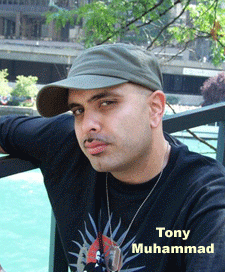
tony muhammed When an up and coming local emcee known as Wrekonize won the second MTV2 MC Battle in November, it grasped the Hip-Hop world’s immediate attention to not only him, but to the big question “What kind of Hip-Hop do they have in Miami?” Obviously, Wrekonize did not fit the profile of what many deem as the norm for what has come out of Miami Hip-Hop historically. What has been typical has been either the booty shaking, bass filled, sexually-oriented sounds of Uncle Luke or the bounce-oriented materialism found in a Trick Daddy or Trina type song. This young artist is light skinned (or “white”), clean cut, with a complex traditional culture (or “true school”) flow that would blow away most emcees in the spot light today. In finding out more about his background, it would lead many people to scratch their heads even further.

Originally from England (of both English and South African descent), Wrekonize moved with his family to Miami Beach at a very young age. He remembers how his parents were very much into the East-Coast Hip-Hop that was around at the time, with artists such as Heavy D and the Boyz and Guru when he was heavily pumping the Jazzmatazz in the early 90s. Soon after, he and his family moved to Broward where there was nothing close to there being a Hip-Hop scene at the time. During his high school years in the late 90s, he would visit Miami, constantly in search of a true Hip-Hop scene. He found flyers in various spots promoting underground B-Boy events held at the Polish American Club. He began attending them and became very moved by the emcee battle portions of the venues. This was so much so, that he decided for himself to polish up his rhyming skills and begin entering in some of these battles. He recalls participating at one of the very first Who Can Roast The Most? Events, in which he was knocked out of competition early because competing emcees were more known since they all went to Miami high schools, therefore in a better position to gain favoritism by local judges. But he didn’t allow this to keep him down. In a very untraditional way, he would prepare for battles at home by “picking objects in a room and describing them or finding things to talk about with different people.” He describes the sharpening of his rhyming skills as “a train reflex that you have to really keep up with, if not it will get real dusty and you’ll get real slow.” Yet, Wrekonize did not start making a name for himself in the local scene until another battle rapper by the name of H2O befriended him at the Who Can Roast The Most? events, in which they hooked up and formed the Illiteratz along with a third emcee and began to “infest all the jams.”

Wrekonize

Wrekonize

After a while, Wrekonize indeed began to become recognized for his skills and would win a considerable amount of battles. It led to the point that many held him as practically unbeatable. His reputation pushed him to enter a contest advertised by 103.5 The Beat, in which the winner would compete at the second MTV2 MC Battle. After winning the determining battle at Envision Studios in North Miami, it was off to New York, to compete at the national level, and eventually to ultimate glory. Wrekonize described the experience as being “great.” He added “MTV took real good care of us.” He mentioned how better organized the second battle was compared to the first (broadcasted in September) and how much wittier the battlers were. He also said that the battle “was more of a battle of nerves,” considering that he was out of his “natural surroundings” in competition with emcees totally unknown to him and crowded by cameras, which affected his performance at times. At the same time, in a positive light, the venue did not hold the same amount of people as other more grueling events he has competed in like Scribble Jams, which had an audience of thousands. He stressed that “The Cameras hid the fact that so many more people were actually watching.”

Reflecting on other aspects of the battle, Wrekonize mentioned how MTV awarding him $25,000 for winning “looks legitimate.” Yet, the promised deal with Rocafella that came along with it is “still in the dark.” He admitted “I really don’t know how they were going to work it out.” He continued “Throughout the whole battle it was weird. The judges (all artists on Rocafella) had an incredible amount of plug ins about their CDs coming out, which was disrespectful. It became a theme throughout the battle.” He explained how the battle had an added ending after the cameras were turned off. He stressed “When it all went down, Damon Dash gave us a pound and gave us a mixtape, like ‘Here, go buy our albums.’” Determined to capitalize on the experience regardless, Wrekonize firmly stated “It was a little strange, but we came back to Miami with the attitude that we’re going to continue to do this with their help or without their help.” And this, he has shown and proved, by receiving considerable press recently from the Miami New Times and XXL and making appearances on TRL and Video Mixx.

Wrekonize’s producer, Nick Fury, points out that “For a long time now, Miami has had no presence in Hip-Hop.” He describes the styles emulated by Trick Daddy and Trina, which is what is normally expected to come out of Miami, as “more of an amalgamation of different styles, which is off the Hip-Hop tree, but it is not the core essence of what we do.” He added with “I think with Wrek winning the battle, it reaffirmed what we always knew. We have ill emcees down here. Everyone saw that Miami won this.” Nick mentions several Miami Hip-Hop artists that expressed an organically-pure (or true school) flavor in the mid-90s such as Mother Superia and Society who were signed to record deals and appeared on programs such as Rap City and Teen Summit but then disappeared from sight before given the opportunity to make some major noise. Living true to his ideology, Nick makes it his profession to not only do production work for artists, but develop them intellectually and steer them on the right path. At his studio he teaches all whom he mentors, including Liquid Shield producers Da Deala and Profile, about the true history behind Hip-Hop and the music that has accompanied it. Such artists and producers all express great appreciation for having such an inspiration in Nick.

True indeed, not only do Wrekonize and Nick Fury attest to a huge Hip-Hop underground scene that has been neglected in terms of exposure, but also others such as Funk Jazz Lounge resident DJ Snowhite sheds light to the darkness. In 1997, she launched her South Beach venture “Faatland,” a Hip-Hop/poetry open mic venue with live band performances, which is still on the tongue of many in the underground circuit. She started the venue in response to the demand that was around for an open mic Hip-Hop spot after Fat Tuesdays shut down in 1996; a demand that was fueled by the underexposed true school flavor that many Miami Hip-Hop heads expressed. Snowhite commented about why the underground scene has never received the exposure that it rightfully deserves “I blame it on radio. Everything you hear is controlled. People only know of those they hear. How can other emcees have support and gain recognition if they can’t even be heard? How many out here know about Mother Superia, Mangu, Mic Tha Rippa, and countless others. The other Hip Hop music is not corrupt enough to be on the airwaves or picked up by major labels.”

Crazyhood Productions’ DJ EFN has a different opinion about the radio’s impact on Miami as he has seen how it has shaped Miami culture in recent years – going from times in which no Hip-Hop was being played on the air waves to the way Miami is today, with three competing Hip-Hop playing stations. He expressed in an interview that radio has promoted cross-interest in the different forms of Hip-Hop expression in Miami and how he eventually wants his own radio show to teach about the true history of Hip-Hop. EFN stressed “That’s needed to turn Hip-Hop more of a culture in Miami.”

Stay tuned next month for part II.