Editors Note: Looks like Marketing to the Hip Hop crowd is a priority for some, but for the record Dennis Kucinich and Al Sharpton have been dealing with the Hip Hop audiences long before Dean, but its nice they are reaching out..
-Davey D-
============================

Howard Dean
Wil Bannister aka Wil b, and Lu Chi Fu Music’s, Erick Bennett, have been asked, by Howard Dean campaign advisor and organizer, Jasper Hendricks, to organized and head up a “council” of notable Hiphop artists and influential members that will sit with Gov. Howard Dean, the current Democratic front-runner, LIVE and IN PERSON, IN OUR COMMUNITY, moderated by Lu Chi Fu Music’s flagship artist, and author of the controversial Hiphop song, “DEAR MR. BUSH”, WIL b.
Being called “A Hiphop Town Hall Meeting with Howard Dean, the event is expected to be attended by various members of the Legendary hierarchy of the Hiphop community, TBA on a later date, LIVE in Los Angeles at a Church, also, to be disclosed on a later date; All due to the necessary security precautions for the event.
We anticipate this historic gathering to be a deciding factor for the Dean campaign in the urban communities. Details of the event will be released, on January 15th, once all are confirmed, however, organizers Wil b and Erick Bennett, say this event will not only be historic for Hiphop, but it will also serve to bridge that gap that is often found between the Hiphop community and our political officials. Because of a lack of understanding of the needs of the people in the urban communities.
Check out www.LuChiFuMusic.com or www.DeanForAmerica.com for details and updates, daily.
Available for FREE download on our www.LuChiFuMusic.com website, Dear Mr. Bush”, the controversial new single from, Wil b, was almost sidelined recently after Secret Service Agents investigation of the lyrics of rapper Eminem led them to the lyrics of Wil b’s “Dear Mr. Bush”.
With lyrics, such as,
“how did you manipulate a war from our post-dramatic trauma…”,
when referring to questions of the Presidents knowledge of a possibility of a September 11th prior to the actual tragedy,
and,
“Dear Mr. Bush, man, it’s all so clear, why we travelin for war, when you got it right here. I see terror everyday, man, we live it over here…”
It is no surprise, but we are happy to announce, that, no investigation has been planned that we know of. We will definitely keep you posted.
LU CHI FU MUSIC ANNOUNCES:
www.DEARMRBUSH.com
Also, our, www.DearMrBush.com will be up and running towards the end of January just in time for our planned First Annual Hiphop Town Hall Meeting with Howard Dean.
The website is a free site for all users that will allow people of all ages, races, and etc, to write letters, anonymously if desired, to the President of the United States, George W. Bush.
Websites users will be able to voice their real concerns about their world, and, post their comments and opinions.
Not to worry Bush supporters, we, welcome you to, please, send us your comments and facts supporting your president. The result is to inspire creative and fair dialogue amongst us all.
To make it as simple as possible for the President to access and read the letters posted on the DearMrBush.com website, rapper and website developer, Wil b, promises to post all new letters, in order received, on the main page of the DearMrBush.com site, as well as, a confidential reply option for the President to reply to the letters.
“He should get himself a nice cup of Pepto Bismal, his laptop, and read the real opinions of the people in America that these so-called accurate polls seem to always miss. We make up more than half of our population, if you combine the various ethnics in the urban communities. DearMrBush.com is the voice of these people. All you need to do is have a concern, a solution, a question, a comment, or whatever for Mr. Bush.
It is not a let’s bash George party at all.
It’s a way for kids, who can’t vote, prison inmates who may have lost their rights to vote in the prison system, but not their voices, especially because most of these inmates have loved ones that are still in the these streets surviving. It is for everybody. If you LOVE George, then, love ’em. If you hate ’em, then, here at DearMrBush.com, you can say that too, anonymously if you so desire. We need more dialogue and less rhetoric. The Hiphop community and the urban communities of America are in need of a leadership council that will deal with these issues instead of putting together these weak efforts to self-serve. This forum will deal with those issues and whole lot more affecting our kids in our communities, as well as, the globe. We need better schools, more and better jobs, less drugs and more programs, less prisons and more schools, fair and equal housing, positive reinforcements for our struggling programs that, out-of-pocket, provide services to their communities in hopes to better them.
We need opportunities in our community. Whether you believe it needs to be affirmative or not, in the ghettos of America, We NEED ECONOMIC ACTION, NOW!!!
WIL b Comments on his recent activity with the HOWARD DEAN Campaign
I am honored that my message got to em that way (Howard Dean). Their giving us an opportunity to lie out, an agenda that we feel will positively affect the people who come from and live in the ghettos of America. America will get to really see the issues and conditions affecting our people and our community.
Howard Deans people came to me and said he wants to learn about what really is important to OUR community. George W. Bush hasnt as of yet made that request to me or anyone else that I know of, and I dont suspect hell be coming down to the hood to talk shop, but Howard Deans decision to honestly seek the knowledge by breaking bread with the us in L.A., on our terms, may not assure my vote, but it does my respect. The road to the presidency SHOULD go through the ghetto.
If you, as a candidate, are not dedicated to changing the lack of schools, high crime, and zero opportunity situations that are plaguing our communities, then, you are not representing all of the people. Because there are a whole lot of us, who have yet to have been heard, until now.
Besides, this is my chance to give Hiphop’s REAL legends their Nuff Respect, see it!”
– Wil b
In closing, Wil b has been recording a few new songs, for his debut “KIDS KILL KIDS” album, including a song titled “Hush” that he’ll be debuting during a performance tomorrow night (Jan. 6th) at small intimate “unplugged style” event, in North Hollywood, California honoring the organizers and participants in the Anti-War movement, hosted by and starring Michelle Shocked, others (undetermined at press time), and, of course, Wil b.
Check our website www.LuChiFuMusic.com for, Wil b, updates and appearances.
Also, check out this link: la.indymedia.org/news/2003/12/99007.php, to see a live performance by Wil b during a rally takeover on the corner of Hollywood and Highland in Hollywood. We shut it down, baby! Wil b
More to share but not enough time to write it all. Give us a call, or just visit our website daily. We really want you to be a part of this movement and all of this success that will be associated with it. It is ALL about to happen. We are not only taking Hiphop back, we are realizing the beginning of the manifestation of Tupac and Dr. King’s dreams combined. Hiphop has and will continue to save lives and the negative associations will not outshine the brilliant accomplishments of this remarkable culture.
How Can WE ALL be down? Drop us a line by checking out our website and emailing the appropriate contact for your needs.
Blessings,
Megan Garcia, Staff Publicist, Lu Chi Fu Music
c/o Wil Bannister aka Wil b
917-804-2770
www.LuChiFuMusic.com
WilBannister@juno.com
LuChiFuMusic@juno.com
LuChiFuMusic@hotmail.com




 T
T
 Having been General Manager of the multi-platinum group Wu-Tang Clan with whom Killarmy, the group Mr. Russert mentioned, was affiliated, I can, with authority, dismiss the idea that the activities of the alleged sniper are what Killarmy had in mind when they were motivated to record the album Silent Weapons For Quiet Wars. I was there when they recorded the album, knew the young members of the group personally, and at times, conducted business on their behalf as it related to Wu-Tang Clan.

 When the Los Angeles Times article came out implying that Biggie was the mastermind behind the murder of Tupac I immediately recognized that some force(s) was attempting to use the murder of both rappers to divide the Black community, in particular, in a manner similar to how the murder of Malcolm X had been used, for over 30 years.
 Remember what I included last week of the contents of a letter Lt. Col. Fletcher Prouty, author of the book JFK, wrote to me. He wrote of his covert responsibilities in the U.S. government as well as what was really involved in the assassination of President Kennedy, beyond the murder itself:
 That after nearly two years of no
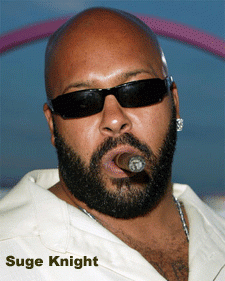
 In some way, something similar has to happen where Tupac and Biggie’s murders are concerned, if healing is to take place and manipulation is to be ended. It would be helpful, if Tupac and Biggie’s families and Suge Knight and Sean Combs with the help of their supporters, spiritual leaders, advisers, and East and West Coast artists and music executives, were one day able to put their personal hurt aside and recognize and understand that their pain and emotions are being used to divide whole communities. P. Diddy was present that night in the Apollo when the Minister and Sister Betty began to publicly reconcile. Before, during, and after that Apollo meeting, Minister Farrakhan called for the government to open the files on the assassination of both Malcolm X and Dr. Martin Luther King. Puffy’s relative public silence on the matter of the Los Angeles Times story on Biggie should be studied. It has had both a positive and negative affect on the situation.
 To our knowledge, not a single major Hip-Hop magazine has done a cover story on 1)The fact that the NYPD in 2001 openly admitted that it has the New York Hip-Hop community and industry under surveillance 2) The DEA and Houston Police Department’s investigation, use of informants, and COINTELPRO-like tactics in the investigation against Scarface and Rap-A-Lot Records in 2000 3) The federal investigations – FBI, ATF and IRS pertaining to Tupac, Biggie, Death Row and Bad Boy or the fact that both artists were under surveillance in the general time period or night of their murders.
 From my experience and point of view the whole thing was an elaborately planned conspiracy to accomplish a Coup d’etat. To do so it was necessary to kill JFK, among other things. This is why there has never been any prosecution or trial for anyone since that crime. A coup d’etat of such dimensions is carefully planned, is the consensus decision of many powerful people, and then the work of pure professionals who are highly skilled.
 It can certainly be said that competition and frank verbal communication are what make Hip-Hop, in certain ways, very special. There is a tremendous value placed upon the full expression of the individual in Hip-Hop, which is admirable. And there is a constant attention placed upon the improvement of one’s skills and the mastering of their craft. Comparisons play a big part in this. It is hard to not watch or read a Hip-Hop interview where one artist is not compared to another. Comparisons are not inherently bad. Neither is competition. But the same can not be said for invidious comparisons which now seem to be increasingly common in Hip-Hop and in the positioning of Hip-Hop artists in alternative, Black and music industry-related media and particularly in the mainstream media, which serves an audience that is unfamiliar with the nuances of the Hip-Hop community and industry. That is why it was so easy for those who get their picture of Hip-Hop from the mainstream media to be deceived into believing that the murders of Biggie and Tupac were the result of an East Coast/West Coast rap feud – a picture that was largely created by provocative articles written in Hip-Hop publications fed by the actual words of Hip-Hop artists.
The Hip-Hop Hypocrisy
“I remember asking my Mom what she did to make pops hate us so much. I couldn’t have been much older than eleven at the time, but I can still remember the anger I felt. Mom broke down into tears and tried to explain it to me, but I couldn’t understand why other kids had their fathers taking them to ball games and stuff, but mine didn’t even take the time to wish me well on my birthday.”
Donald paused a moment to reflect. His expression was a mask of bewilderment and pain. “I used to think that if I could become a good enough kid, it would make my pops want to spend time with me. But the only time my pops really talked to me was when I got into trouble at school. Mom would threaten to send me away to a training school and pops would come over and beat me and lecture me on why I should stop cutting up in class. Many times I would get in trouble just so I could see him and ask him, after he beat me up, if he would come to my basketball game and watch me play. I just wanted him to be proud of me, to love me, but I ended up hating him and everyone around me because he couldn’t.”
When I first heard Donald Williams‘ story, I made a vow to one day tell it to the world. It was a painful tale of a young man attempting to somehow deal with the absence of a responsible father. Donald’s words were filled with rage and interlaced with a venomous sense of hatred. Yet, underneath the anger, there seemed to be a hint of tears. He was in pain, he was hurting, and the man responsible for this devastation didn’t seem to care.
“When I got sentenced to prison, he came here to visit me a few times. He tried to preach to me and counsel me and tell me how wrong I was for selling drugs and living the criminal lifestyle. Man, he even sent me a bible and tried to tell me to give my life to Jesus. But it was too late. After all these years without him, what made this fool feel like he had the right to step into my life now and give out fatherly advice. I would’ve worshiped Satan before I listened to a thing he had to offer. Whenever I looked at him I wanted to just grab his neck and squeeze it and squeeze it and squeeze it until every ounce of his miserable life oozed out of him. I hated that man more than I have ever hated anyone in my life.”
Donald took his father off the visitation list and swore that he never wanted to see the man again. In my presence, Donald never allowed a tear to trail down his chocolate face. But I can imagine those tears came, often, in the middle of the night while contemplating the hate that a father’s neglect created.
Horrific stories of men who refuse to play an important role in the lives of their children are well known. It is an issue that must be dealt with firmly; with serious consequences handed down to offenders. But I am writing this article because I know of another story of blatant child abuse that may hit closer to home than you realize.
It is the story of a child named Hip-Hop.
Afrika Bambaataa
It was born out of raw sense of expression that led many black kids to turn basements and dormitories and bedrooms into impromptu studios. Inner-city geniuses began experimenting with an art form that had the promise of becoming a powerful force in the community. It was fun and competitive. Street corners became the breeding ground for aspiring emcee’s to get their first taste at moving a crowd. With pioneers like Afrika Bambaataa and Kool Herc and Grandmaster Flash, along with many others leading the way, rap music exploded into the hearts of young black kids across America.
Along with the birth of Hip-Hop came the emergence of annoyed critics within the older black generation. They wrote Hip-Hop off as a fad that would die out in two or three years. They were far more concerned with stepping across the railroad tracks into the American Dream than paying much attention to the silly Hip-Hop kids with high-top hair cuts who used their mouths to beat-box. (The current Hip-Hop critics who claim to only be against “gangsta rap” are no more than intellectual hypocrites. Vocal members of the older generation disowned rap music even in its infancy – well before it became a vehicle for some artists to disrespect females and illustrate the horrors of street life.)
As a result of the older generation’s neglect, many of Hip-Hop’s leading pioneers ended up signing horrible contracts that gave opportunistic new labels total control over their lives and careers. Instead of influential black leaders using their experience and wisdom to reach back and help Hip-Hop grow into a positive, more focused force in the black community, far too many of these leaders (and rap critics) made the decision to disassociate themselves from the music. Hip-Hop didn’t seem to fit into the cultured, intelligent, and civilized image that they were trying to project to White America.
Still, Hip-Hop grew. Talented poets from all over the country were eager to contribute their vision to the music. Run DMC, LL Cool J, Kool Moe Dee, KRS One, Ice-T, Rakim, and a host of others continued to build upon the foundation of Hip-Hop. Mistakes were made, egos clashed, but rap music followed the beat of it’s own drummer and continued to make huge strides forward. Soon, rap music began reaching the ears of white suburban kids. As a result, Hip-Hop entered the radar screens of white corporate entities as a marketable (and exploitable) commodity. Money was offered, deals were made, and contracts were signed.
Nowhere in this equation did black intellectuals step in to offer guidance and “fatherly” advice. White lawyers in fancy suits shuffled tons of paperwork in front of new artists, enticing them to sign over all their publishing rights for a few pennies. Had more brothers with insight and experience stepped up to the plate to defend the rights of these early artists instead of criticizing them, maybe less rappers would have been raped financially. Tales of bankruptcy and poverty amongst the early innovators of rap music will forever be a footnote in the history of Hip-Hop.
Still, Hip-Hop survived. Though battle-weary and bruised, the music produced prophets who attempted to fill the void left by the older generation. Groups like X-Clan, Public Enemy, and KRS One tried to teach the masses about black power and unity. “Self-Destruction” became an anthem for change as artists from across the spectrum joined together to promote positive interaction. This would have been the perfect time for the intellectual critics of Hip-Hop to reach back and steer rap music onto the Yellow Brick Road to redemption. Instead, these critics turned their backs on Hip-Hop and settled down into their little house on the prairie, beside the Waltons.
Now, in the wake of Tupac and Biggie‘s death, as Hip-Hop struggles to redefine its identity and purpose, there seems to be a resurgence of black critics banging down the door to CNN’s studios hoping to spit out a few intellectual sound bites that will impress their colleagues. Sideline opinions from people who have never even listened to rap music seem to be becoming the norm. More and more black leaders are claiming to be upset that the white corporate structure is exploiting the talents of young black males, and that most artists are too blind to recognize this.
My understanding of history is based more on facts. The truth is, it took white media outlets to embrace Hip-Hop before black-owned media outlets realized that it was “okay” to feature rap groups (the only exception being Soul Train, Ebony, and Jet). It was only after Nike and Reebok and Mountain Dew and Sprite used Hip-Hop artists in high-profile commercials did black-owned companies accept the idea. Quick research will show anyone who is interested that Forbes and Time Magazine had cover stories detailing the economical power of Hip-Hop moguls years before Black Enterprise had the courage to tackle the issue.
Donald Williams wasn’t perfect. Neither is Hip-Hop. They both traveled down a lonely road filled with foolish mistakes and very bad choices. But I understand their anger when, after years of neglect and disappointment, irresponsible father figures tap-dance their way back into the spotlight with two-cent opinions on what the young should and shouldn’t do. The words that Donald said to me, seven years ago, seem to be the same words that many Hip-Hop fans are screaming out today. “After all these years without him, what [makes] this fool feel like he [has] the right to step into my life now and give out fatherly advice.”
Marlon leTerrance is a regular contributer at BlackElectorate.com. As a product of the Hip-Hop Generation’s maverick disregard for conventional thought, Mr. leTerrance writes from the perspective of the “disenfranchised street dwellers, disillusioned by the Struggle”. He can be contacted via e-mail at MarlonLeterrance@aol.com