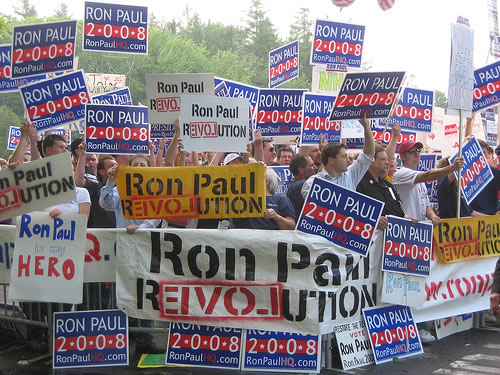
 For years Ron Paul has sat in the halls of Congress talking a good game about how he wants to audit the Feds, ultimately abolish it and clean house.. He’s garnered a strident, loyal following of folks who in many ways gave the country a glimpse into the fiesty, cantankerous, defiant attitude that some would be characterized as part of the Tea Party Movement. I was in NH during the 08 primaries when I ran into Paul and the Ron Paul Revolution… They were impressive in terms of kicking up dust..Folks were standing out there in the cold making sure their presence was felt and that everyone within earshot would know Paul’s name.
At the same time I later got to interview Paul and his son Rand who is will be taking his seat in the Senate come January. During our discussion, myself and a conservative reporter whose name escaped me, asked Paul about his willingness to take money from the KKK and other white supremacist organizations that had his picture and links to his site on their sites.
Paul didn’t blink an eye and said he had no problem taking money from them and would continue to do so. When asked would he give the money back and denounce them, Paul hedged and said he doesn’t follow their beliefs and that he would not give back their money. That raised a lot of eyebrows..
When we played the interview on the air we got a lot of angry calls from Ron Paul supporters who insisted that he was not racist and that he can’t help that White supremacist were supporting him.. This is essentially what Rand said to us in response to his father’s remarks. He said his father believes in freedom of speech and he wasnt a supporter of the KKK and their activities..
The discussions would quickly move from Paul and then KKK to him wanting to dismantle the Fed, and start hauling folks off to jail for financial wrong doing. We’ll come 2010 his opportunity will be there. He’s set to chair the House Subcommitte on Domestic Monetary Policy. The question is will he succeed in doing what so many others have failed? Will he shake up Washington? Will he follow through or meet the same corporate backed forces and lobbyist who thus far have shut down, run out of town and brought off damn near everyone who has tried? It’ll be interesting to see how the people who have long championed the Ron Paul Revolution feel if he doesn’t. Will they become as disillusioned with their man the same way many young Obama supporters got disillusioned with him when Washington didn’t change?
-Davey D-
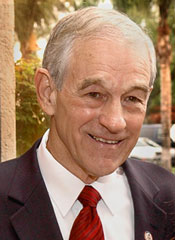
Ron Paul
The Revolution is here! Searching for leadership, congressional Republicans have finally turned to Ron Paul. Well, to chair the House subcommittee on domestic monetary policy, at least. But that does put Congress’s leading critic of the Federal Reserve in charge of the panel that oversees the central bank.
Ben Bernanke, beware. The 12-term libertarian-leaning congressman from Texas has written a book-length manifesto – titled simply End the Fed – calling for the Federal Reserve’s abolition. He will likely call leading Austrian economists affiliated with the Ludwig von Mises Institute to Capitol Hill to testify alongside staid mainstream economists. Fortune magazine recently asked, “Will the Fed be able to survive Ron Paul?”
For years, Paul laboured in obscurity. He ended his first stint in Congress with an unsuccessful run for US Senate in 1984 (he lost to eventual Senator Phil Gramm in the Republican primary). Before returning to the House 13 years later, in order to join the stalled government-shrinking “Republican Revolution”, Paul was the Libertarian party’s presidential nominee in 1988.
But it was Paul’s first Republican presidential campaign in 2008 that really put him on the map. Debating alongside John McCain, Rudy Giuliani and Mitt Romney, Paul stood out as a voice for peace and civil liberties. Unlike all the other Republicans on stage, he opposed the Iraq war and the Patriot Act. A strict constitutionalist, he was also more consistent than the rest of them in his rejection of debts, deficits and runaway government spending.
Paul’s views on war and peace remain deeply controversial within the Republican party. When Paul defended Wikileaks founder Julian Assange, for instance, the conservative blog RedState denounced him as “al-Qaida’s favourite member of Congress”. But when it comes to economics and the requirement that federal legislation be explicitly based on the Constitution, Paul’s philosophy is starting to resonate.
continue reading this article in the UK Guardian


 You don’t think they already know who’s there and who isn’t? I’m not saying its correct or desireable. I am simply saying in this case I gotta go along with Luda, in 2010 we need less vacant lots, more school supplies and extra money in our neighborhoods. Its our tax dollars providing them so might as well fill out the form and not trip. If I really wanna disappear off the grid, I can start by shutting down my Facebook page, Twitter account, toss my cell phone and somehow try to remove my all the photos people have posted of me on the internet and hope to God I can avoid high-tech recognition software. I can do all that and also hope that somehow in their zeal to collect fed monies for any number of law enforcement programs that I wasn’t somehow profiled and catalogued in some sort of traffic violation, gang, activist rabble-rouser police database
 To be completely honest when you look at Paul and others who take the position that the borders need to be closed and walls erected, I can easily see folks who support his position alerting law enforcement about those who are undocumented. That has nothing to do with the census and has everything to do with increased xenophobic attitudes.
 Last week Congress voted to encourage participation in the 2010 census. I voted “No” on this resolution for the simple, obvious reason that the census- like so many government programs- has grown far beyond what the framers of our Constitution intended. The invasive nature of the current census raises serious questions about how and why government will use the collected information. It also demonstrates how the federal bureaucracy consistently encourages citizens to think of themselves in terms of groups, rather than as individual Americans. The not so subtle implication is that each group, whether ethnic, religious, social, or geographic, should speak up and demand its “fair share” of federal largesse.


