 This is a pretty good interview w/ Snoop Dogg done by the homie DJ Skee.. Here snoop talks about his transition from Snoop Dogg to Snoop Lion.. He talks about the life circumstances that led to him digging reggae. Snoop explains he’s long wanted to express himself in a variety of ways including wanting to sing..He also notes that he’s become more spiritually grounded..He now puts family first and music second.. It took a while for him to evolve to that mindset..
In this interview speaks about the new album he’s working on and the folks he has involved..He explains why he made the assertion about being Bob Marley incarnate..
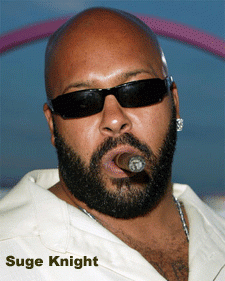
Many were curious as to how and why Snoop was willing to reconcile with former Death Row CEO Suge Knight.. He says that Suge gave him a voice early on in his career and no matter what their differences , that fact can’t be changed or overlooked. He said it was important to be the bigger man and spark peace.. A lot of ground gets covered in this interview. The only question missing was why Snoop who is a die-hard Steelers fam was in the Ice Cube 30 /30 documentary on the Raiders sporting a silver and black jersey..



 The Rolling Stone article, even though it acknowledges that the first effort to link Suge Knight with the murder of Biggie had some very serious problems with it spends not so much as a whole paragraph detailing how Brill’s Content and the second LA Times reporter poked wholes in the initial theory. Instead, Rolling Stone writer Randall Sullivan spends tens of thousands of words dropping seeds and speculating that Suge Knight, some LAPD officers and an individual named Amir Muhammad were involved in the murder of Biggie.
 “One week after Russell Poole took over the Biggie Smalls murder investigation, the media learned that as many as a dozen law-enforcement officers had been on the scene when Smalls was shot to death. Six cops had been working for Smalls that night. The rapper was being shadowed as well by an assortment of undercover officers from the New York Police Department and the Federal Bureau of Alcohol, Tobacco and Firearms. The New York cops believed that the same man who shot Tupac Shakur at Quad Studios had killed by one of their off-duty officers and might still be working for either Puffy Combs or Biggie Smalls. The ATF officers were part of a federal task force investigating allegations that employees of Death Row Records were involved in money laundering and the sale of stolen weapons.”
 Why would a supposedly enterprising reporter like Sullivan not work his investigation from the actual scene of the shooting? Why do we have so much information in his article about people at the party that Biggie attended before the shooting where “Muslim-looking” individuals and off-duty police officers connected to Death Row were seen, and so little information about the government agents and undercover NYPD officers following Biggie’s car when he was shot?
 A basic reading of the story indicates that Sullivan directly or indirectly was fed information from people in the U.S. government who have been watching Death Row and Bad Boy Records and who work with the LAPD and NYPD. No one can reasonably refute that from the manner in which Sullivan quotes unnamed sources and weaves in information into his story that had to have been given to him by the government itself, or through others in touch with the FBI or Justice Department.
 B
B
