Greatest Posse Cut of All-time: Juice Crew’s Symphony vs Wu-Tang’s Triumph-Who wins?

Juice-Crew-vs-Wu-TangBeen having a heated debate about the greatest pose track of all time… There’s been lots of landmark cuts to choose from like Main Source‘s Live at the BBQ which featured a young Nas among others..

You had Craig Mack‘s Flava in Ya Ear which featured notables like Notorious BIG, Busta Rhymes and LL to name a few..

Of course we had Tribe Called Quest‘s  Scenario which featured Leaders of the New School and the late Kid Hood.  But at the end of the day you gotta narrow it down to two tracks..

One of my favorites is Heavy D‘s slept on track .. A Buncha Ni— which featured among others Guru and a young Notorious BIG who made his debut

Juice Crew.. The Symphony which features Big Daddy Kane, Kool G Rap, Craig G and Master Ace. When that song dropped in ’88 Hip Hop changed for the better. Everyone had to step up their lyrical game. The careers of all those featured took off and almost all featured on that song were immortalized within the Hip Hop annals …

http://www.youtube.com/watch?v=XbsPTkwqWCI

It would be almost 10 years before another quintessential posse cut would come along on par with the Juice Crew. In ’97 the Wu Tang Clan dropped Triumph where all 9 members of Wu-Tang including Capaddona came along and like the Juice Crew before them changed the game.

http://www.youtube.com/watch?v=isumZjs3dKA

its always been a Hip Hop fantasy to speculate as to what would happen if the Juice Crew squared off w/ Wu-Tnag in a lyrical battle.. Who would match up with who? How would things go down? Juice Crew’s Symphony vs Wu-Tang’s Triumph.. Which is the Greatest of all-time?

What is Hip Hop?: A Historical Definition of Rap pt2 (Street Hustlers to Revolutionary Poets)

Davey-D-purple-frameThis is part 2 of an article we penned called  The Historical Definition of Rap pt1. In that piece we talked about how the term Rap had been around long before DJ Kool Herc and his sister Cindy Campbell threw that first landmark Back to School party August 11 1973 in the community center at 1520 Sedgwick Ave in the Bronx.

Many are not aware that when Herc and his partners Coke La Rock and later Clark Kent rocked the mic, they used the words ‘rhyming’ and ’emceeing’ to describe their vocal expressions. The word Rap became attached to Hip Hop in 1979 with the release of Rapper’s Delight by the Sugar Hill Gang.

Prior to ’79, the word Rap was attached to a variety of other vocal activities most notably slick, persuasive talk from street hustlers, pimps and players. Rapping was all about mesmerizing and dazzling folks with words with an end goal of convincing one to give up everything from money to property to sexual favors. if you were said to have ‘a good rap’, then it meant you had the gift of gab which in many circles was revered and respected.

Dolemite

Dolemite

With respect to the act of rapping, many seem to think that saying rhymes in a syncopated fashion over music is unique to Hip Hop. That’s a mistake. To not see Rap as something that is rooted in deeper histories, is to short change Hip Hop culture. Simply put Rap is part of a continuum. Every generation within Black America can point to an activity or music style that included rap-like vocal expressions. They range from little girls doing double dutch jump rope to young kids doing engine engine number nine type rhymes to determine who would be it when playing tag.

We’ve seen expressions that we associate with rap today show up in the form of popular artists like Rudy Ray More aka Dolemite who did tons of movies where he did routines like his signature Signified Monkey .

We saw it surface with singer song writer Clarence Reid aka Blowfly who did x rated songs like Sesame Street and Rapp Dirty which was released in 1980 but according to him was written in 1965.

Both More and Reid come from a generation where street talk that encompassed rhyme was not unusual. Sometimes called signifying, testifying or playing the dozens, such expressions are key foundations and precursors to Rap.

We saw Rap expression show up in songs like Here Comes the Judge released in 1968 by comedian Pigmeat Markham. Although not called ‘rap’ it clearly could stand alongside anything we hear today.

http://www.youtube.com/watch?v=DvMBxlu62c0

We saw rap with Louis Jordan and his group Tympany Five and their landmark cut The Meeting which was released in 1962

In the same vein as Pigmeat is actor Lincoln Perry better known as Stepin Fetchit. The controversial character who many felt kept alive nasty stereotypes of Black people being lazy and shiftless was during his heyday in the 1940s,  the most successful Black actor in all of Hollywood. In this memorable scene from the 1945 musical Big Timers we see Perry hit up the piano and rap, decades before what we know as Hip Hop emerged..

http://www.youtube.com/watch?v=5qALvc-MIDY

Last Poets

Last Poets

We saw Rap expressions manifest itself in the form of revolutionary acts like the Last Poets, Gil Scott Heron and the Watts Prophets who are considered the grandfathers and godfathers to  modern-day rap. These acts emerged on the scene in the late 60s early 70s with the express purpose of providing sound tracks for the various Black liberation struggles taken place all over the country…Songs like When the Revolution ComesThe Revolution Will Not Be Televised and Tenements respectively exemplified the type of vibe they were kicking on the eve of Hip Hop’s birth.

Over the years not only have many of the songs from these acts have been sampled, but some of these acts have from time to time been featured in songs with popular artists. For example the Last Poets are featured on Common‘s song The Corner and NasYou Can’t Stop Us Now‘ which borrows the baseline from a classic  Temptations cut ‘Message to a Blackman

The Last Poets rap influence is shown on cuts like the White Man’s Got a God Complex which was featured on the ‘This is Madness‘ album (1971). It was remade 20 years later by groups like Public Enemy and Def Jef. Below is the PE version which keeps alot of original cadence in tact.

The Def Jef version of  God Complexx, shows not only the influence of the Last Poets but also Gil Scott-Heron as he uses the beat from Revolution Will Not Be Televised.

Ironically groups like NWA who were perceived as having an anti-revolutionary message sampled the Last Poets ‘Die Nigga‘ off their album ‘The Original Last Poets Right On‘ (1970) and made them known to younger generations with songs like ‘Real Niggaz Don’t Die‘ off the ‘Efil4zaggin’ (1991)

https://www.youtube.com/watch?v=6jy6Nebd_e0

GilScottheronGil Scott-Heron is often called the Godfather to Rap. It was a title he shunned, stating he preferred to be known as a bluesologist. Nevertheless, Heron was a towering figure whose signature song Revolution Will Not be Televised was redone by too many Hip Hop artists to name. Cuts like B-Movie and ReRon which were released in 1980 and 1984 respectively demonstrated his Heron’s rapping ability.

He was also one of the first artists from the 60s/ Black Power generation to jump on a song with than modern day rap artists..The anti-Apartheid song Let Me See Your ID  (1985) which features, Run DMC, Kurtis Blow and Mele-Mel to name a few was monumental. The content and purpose of the song was incredible, but also although unintended it contrasted the generational differences in rap styles.

Watts Prophets Rapping BlackThe Watts Prophets have not only been heralded as important figures in the emergence of West Coast rap, but  in 1970 they released an album called ‘Rappin’ Black in a White World’. Many consider that to be the first to use the word ‘Rap’ to describe a  recording that featured rhyming, This groundbreaking album proceeds   ‘Rapper’s Delight‘ by almost 10 years. They also featured a woman vocalist named Dee Dee McNeil who isn’t often named when speaking of the Watts prophets

https://www.youtube.com/watch?v=hHxM71rcQus

One artist who is in the same vein as these revolutionary poets but not as well-known is Stax Record recording artist John KaSandra nick named ‘Funky Philosopher‘. He did a bunch of black conscious songs in the early 70s including one that is many ways a head of its time for the emerging Hip Hop rap scene at the time..  ‘(What’s Under) The Natural Do’ (1970) is an incredible song that talks about Black power  and how folks are gonna have to do more than just wear an Afro hairstyle in order to uplift the community.

http://www.youtube.com/watch?v=tQow4jYVM9I

One can’t talk about the Last Poets, Gil Scott Heron and Watts Prophets and their influence on Rap without talking about the Black Arts Movement which proceeded them and exerted profound influence. BAM  introduced a style of spoken word that was hard-hitting, uncompromising and often recited over Bebop and Jazz. BAM co-founder Amiri Baraka than known as Leroy Jones illustrates that style with his famous piece Black Art.

Baraka’s ‘rap’ along with the spoken word and slang executed by others within the Black Arts Movement were such that it was hard for folks outside the scene to pick up and appreciate.It was for the Bebop crowd who coincidently called themselves ‘Hip’. It was deliberate in challenging the mainstream and being anti-establishment. It’s deliberately uncomfortable Many like to draw parallels to Hip Hop.

http://www.youtube.com/watch?v=Dh2P-tlEH_w

BAM member Sonia Sanchez gives a brief history of that time period and how their spoken word paved the way for modern-day raps heard within Hip Hop. Sonia Sanchez: From Black Arts to Hip Hop

http://www.youtube.com/watch?v=JtRffMdbB0Y

Members of BAM

Members of BAM

Just for added understanding, one may wanna peep this brief documentary on bebop which was the precursor to the Black Arts Movement. Again here you will be able to draw some strong parallel to Hip Hop, especially when you consider that Bebopers called themselves coined the term ‘Hip’ which is how they referred to themselves. Peep  Bebop Jazz the Evolution of Culture Through Music.

These are just a few highlights of the many artists and expressions that are akin to rap to be in our midst before the birth of Hip Hop..Look out for pt 3 which deals with the influence of Black Radio deejays on what we know as Rap..

written by Davey D

10 Outrageous Tactics the Police Are Using and getting Away With

This is a recent article by John Knefel that first appeared in Alternet... It’s called 10 Outrageous Tactics Cops Get Away With. This will probably be one of the most sobering and important pieces you read all year.. I hope folks will take heed and truly understand whats happening right now.. There’s been a serious power grab right before us and very little push back, because folks are distracted or feel it won’t happen to them. many others have grown cynical and see the possibility of change as useless.. Whats useless is believing you can’t change things.. The first step in that is awareness followed by action.. That actions takes many forms.. It ranges from organizing and advocating to voting to harsh refusals to allow business to go on as usual..

As you are reading the article, below you may want to listen to this speech given in August 2008 by former political prisoner and Black Panther Dhoruba Bin Wahad, where he talks about the rise of the police state..

Below is the article explaining whats going on..

-Davey D-

Oaklandpolice-225Talk to someone who has never dealt with the cops about police behaving badly, and he or she will inevitably say, “But they can’t do that! Can they?” The question of what the cops can or can’t do is natural enough for someone who never deals with cops, especially if their inexperience is due to class and/or race privilege. But a public defender would describe that question as naïve. In short, the cops can do almost anything they want, and often the most maddening tactics are actually completely legal.

There are many reasons for this, but three historical developments stand out: the war on drugs provided the template for social control based on race; 9/11 gave federal and local officials the opportunity to ensnare Muslims (and activists) in the ever-increasing surveillance and incarceration state; and a lack of concern from the public at large means these tactics can be applied, often controversy-free, to anyone who resists them.

What follows are 10 of the innumerable tactics the police can use against a population often incapable of constraining their behavior
Police spy1. Infiltration, informants and monitoring. The NYPD’s Demographics Unit has engaged in a massive surveillance program directed at Muslims throughout the entire Northeast region, ignoring any jurisdictional limitations and acting as a secret police and intelligence gathering agency – a regional FBI of sorts. The AP’s award-winning reports [3] on the Demographics Unit helped bring some information about the program to light, including the revelation that its efforts have resulted in exactly zero terrorism leads. [4]

Although a lawsuit from 1971, the Handschu case, [4] “resulted in federal guidelines that prohibit the NYPD from collecting information about political speech unless it is related to potential terrorism,” legal experts worry that privacy rights have been so diminished that Muslims who are spied on may not be able to seek recourse. The AP quoted [5] Donna Lieberman in November 2011, who said, “It’s really not clear that people can do anything if they’ve been subjected to unlawful surveillance anymore.”

Muslims are not the only group that has been targeted. The AP reported [6] that the NYPD has also infiltrated liberal groups and protest organizers. Other cases of entrapment of activists, such as the NATO 5 [7] and the Cleveland 5, are also troubling. [8]

2. Warrantless home surveillance. Just in case you still think there must be some limit on how the authorities can surveil you, there’s this — a federal agency, not the police, but the larger point stands. The Ninth Circuit Court of Appeals recently ruled that it is legal for a law enforcement agent [9] to enter your house and videotape you without your consent. The case, United States v. Wahchumwah, revolved around a U.S. Fish and Wildlife undercover agent who recorded Wahchumwah without a warrant. The Ninth Circuit found the search to be “voluntary,” which led the EFF to write on its Web site: “The sad truth is that as technology continues to advance, surveillance becomes ‘voluntary’ only by virtue of the fact we live in a modern society where technology is becoming cheaper, easier and more invasive.”

The Ninth Circuit isn’t the only one who thinks warrantless video surveillance is perfectly OK. [10]

“CNET has learned that U.S. District Judge William Griesbach [11] ruled that it was reasonable for Drug Enforcement Administration agents to enter rural property without permission — and without a warrant — to install multiple ‘covert digital surveillance cameras’ in hopes of uncovering evidence that 30 to 40 marijuana plants were being grown.”

During the Bush years, Congress had to grant retroactive immunity to giant telecoms that engaged in warrantless wiretapping. It seems, the judicial branch wants to save Congress the trouble.

riot-police_9-2-083. Preemptive visits and harassment. One of the favorite tactics of police departments is targeting activists a day before a large event. We saw this on May Day in New York City, as cops descended on several activists’ apartments before the day of action, [12] and in Chicago before the massive No NATO protests. [13] The Cleveland 5 were also arrested before May Day, and back in 2008 the RNC8 were also preemptively arrested. [7]

4. Creating call logs from stolen phones. If you lose your phone in NYC and report it to the police, they’ll help you find it. So far, so good. Where the agreement turns pear-shaped, however, is what they do with your call logs. The NYPD subpoenas your call log from the day it was stolen onward, under the logic that the records could help find your phone.

But — and here’s the kicker — they get info for the calls you made on the day it was swiped, and possibly even info from your new cell phone if you keep your number. The information is added to a database called the Enterprise Case Management System, and the numbers are hyperlinked for cross-referencing. The call logs, all obtained without a court order and often without the victim’s permission or knowledge, could “conceivably be used for any investigative purpose,” according to the New York Times. [14]

5. Consent searches. Sometimes a cop gives you a command, but phrases it as a question, like, “Would you open your bag so I can look inside?” If you’re anything like the vast majority of people in the United States, you have no idea that you’re under no lawful obligation to answer in the affirmative. You can, legally speaking, ask if you are being detained, and if the answer is no, you are free to walk away. Or at the very least, not open your bag.

Cops are aware that they can intimidate someone they decide to search, and once they obtain “consent” – e.g. “Yes, man with a gun who is towering over me, you can look in my bag” – any evidence of criminality they find can be used in court. This method of searching people was developed, like several other tactics on this list, during the early 1980s when the Reagan administration ramped up the so-called war on drugs.

Many critics argue that the very idea of a “consensual” interaction between police and the public is impossible, if the police initiate contact. As Justin Peters writes [15], “[Police] know the average person doesn’t feel they’re in a position to decline a conversation with a cop.” A common tactic [16] is for officers to say they’ll let someone off with a warning, then proceed to ask a bunch of questions, even though the person is technically free to go.

Police-stopandfrisk-blue6. Stop and frisk. You’ve probably heard about stop and frisk by now, but for years this odious tactic – and close cousin to consent searches – went woefully underreported in establishment media. The NYCLU released staggering statistics for the year 2011 detailing the massive size of the program in New York City. One particularly memorable figure was that the NYPD stopped more young men of color than there are men of color in NYC. [17] (More information at stopmassincarceration.org [18].)
7. Pretext stops (Operation Pipeline). The Supreme Court has repeatedly ruled that cops are free to use minor traffic violations as a pretext to pull over people they suspect of committing drug crimes. Once pulled over, the police obtain “consent” – “Would you get out of the car and empty your pockets?” – and can go on fishing expeditions.

In the Supreme Court’s ruling in Ohio v. Robinette, “The Court made clear to all lower courts that, from now on, the Fourth Amendment should place no meaningful constraints on the police in the War on Drugs,” writes Michelle Alexander in The New Jim Crow. The Court determined [19] that cops don’t have to tell motorists they’re free to leave before getting “permission” to search their car.

In the mid-1980s, the DEA rolled out Operation Pipeline, a federal program that trained city cops in the shady art of leveraging pretext stops into consent searches. The discretionary nature of many of these searches resulted in massive amounts of racial profiling, so much so that some officials say [20] “the reason racial profiling is a national problem is that it was initiated, and in many ways encouraged, by the federal government’s war on drugs.”

8. Police dogs. Don’t consent to cops searching your bag? If you’re in a car or an airport, police can bring in the dogs to smell your stuff, and if the dog responds, they have probable cause to search you without your consent. “The Supreme Court has ruled that walking a drug-sniffing dog around someone’s vehicle (or someone’s luggage) does not constitute a ‘search,’ and therefore does not trigger Fourth Amendment scrutiny,” Michelle Alexander writes.

But if a dog barks or sits, shouldn’t we be comfortable with that triggering probable cause? Radley Balko has reported on the phenomenon of drug dogs giving false positives after reading cues from their handlers [16]:

The problem isn’t that the dogs aren’t capable of picking up the scent; it’s that dogs have been bred to please and interact with humans. A dog can easily be manipulated to alert whenever needed. But even with conscientious cops, a dog without the proper training may pick up on its handler’s body language and alert whenever it detects its handler is suspicious.

This is called the “Clever Hans effect,” [21] named after the horse who could do arithmetic by tapping his hoof. In reality, the horse could recognize the shift in his owner’s body language when he had arrived at the right number.

Drones police 9. Surveillance drones. The drones are coming, and the few illusions of privacy we cling to will soon disappear. The domestic market for drones in the next decade is estimated in the billions, [22] and police departments are chomping at the bit to implement this new technology. Drones already patrol the US-Mexico border, [23] and cities such as Seattle are moving toward using surveillance drones [24]. In August, a North Dakota court ruled [25] that the first-ever drone-assisted arrest was perfectly legal.

In our ever more authoritarian society, [26] expect politicians and the lobbyists who fund their campaigns to justify increased incursions into privacy in the name of security. The short-term incentives to value privacy have been all but forgotten, as “if you’re not doing anything wrong you’ve got nothing to fear” has gone from self-evidently absurd cliché to national motto.

10. Enlist the private sector. The comedian Chris Laker says of privatization: “You can’t privatize everything. Learned that from RoboCop.” But it seems police departments haven’t learned that lesson. In Arizona, police enlisted the help of the Corrections Corporation of America, a private, for-profit prison corporation, in a drug sweep of a public school. PRWatch reports: [27]

“To invite for-profit prison guards to conduct law enforcement actions in a high school is perhaps the most direct expression of the ‘schools-to-prison pipeline’ I’ve ever seen,” said Caroline Isaacs, program director of the Tucson office of the American Friends Service Committee (AFSC), a Quaker social justice organization that advocates for criminal justice reform.

fuck-the-police-occupy-oakland-marchThe privatization of nearly all aspects of public life, from education to law enforcement, is a trend we should all find disturbing, not least of all when a company that profits from locking humans in cages is directly involved in the arrest process.

The larger point here is obvious. In the last decade, the Bill of Rights has been shredded at the federal level and the local level. There are few constraints on police, FBI, NSA, and private intelligence companies when it comes to surveillance of the public. That many of these programs and tactics are discretionary exacerbates and magnifies conscious and subconscious racist and classist attitudes among those who carry them out.

written by John Knefel of Alternet

http://www.youtube.com/watch?v=dKHsGh-y8d8

Diggin in the Crates… 3 Songs by MC Hammer that Folks Slept On that are Nice

MC-HammerBeen digging in crates and listening to a lot of jams that were either forgotten about or totally overlooked..Here’s a few from the one and only MC Hammer who is now an official spokesperson for the City of Oakland.. This is one of my favorite songs from MC Hammer… He teamed up with Tha Dogg Pound and they delivered this banger and many slept on it. It was the Head Hunters album.. which had songs like Pumps in the Bump.. and It’s All Good..

This cut here is called Sleeping on a Master Plan.

http://www.youtube.com/watch?v=uGxqOnZcF5o&feature=plcp

This next song is off the hard to find Family Affair album.. Hammer came at things on a Gospel tip.. I recall when Hammer brought this to the radio station..and he had just started doing a Gospel show at KMEL.. He had some unreleased tracks from Death Row he remade and gave a gospel spin..This cut is called Never Without You..

This next song has an interesting history.. Its one of those unreleased tracks that was remade to a gospel song.. The original cut featured him with Big Daddy Kane and 2Pac..It was called Too Late Playa.. We had copies of that original track but was asked not to play them because Hammer felt the message wasn’t right..he eventually remade the track and did this song called Big Man, a song that talks about domestic violence.

http://www.youtube.com/watch?v=XYZnwEG9b_0

http://www.youtube.com/watch?v=WEsZjaMG7kk

Rollingstone Magazine Fails by Having Only 4 Women featured on its 50 Greatest Hip Hop Song List

Missy elliotThis is the time of year a lot of publications put out End of Year and Best of All Time lists. They’re fun to read as they can take you down memory lane or give you some new perspective on things… At this point in time, you understand there will be a certain bias and there may be one or two names tossed in a list to get people talking. You try to take these things with a grain of salt..
The other day Rollingstone Magazine put out a The 50 Greatest Hip Hop Songs of All-Times. It’s a list that was compiled from a panel of 33 artists, journalists and industry experts. You have luminaries like Def jam co-founder Rick Rubin, former Source editor James Bernard and legendary A&R Dante Ross. Also in the mix were artists like Busta Rhymes, Q-Tip, Nas, Questlove, Boots Riley of the Coup  and Chuck D of Public Enemy just to name a few..You can peep the entire list of judges HERE

You can peep the entire List of 50 songs HERE

When the list came out I went from panel to panel and and what stood out was the glaring omission of women. In fact we don’t have a female artists being ranked for the first 38 entries. That came in the form of Missy Elliot and her song Get Ur Freak On…Personally I thought Missy who definitely deserves a spot has better songs.

The next entries are Lauryn Hill‘s ‘Lost One’s (45) and Salt-N-Pepa‘s ‘Push It’ (46) . The Greatest Hits list list rounds off at entry 47 where have Funky 4 Plus one More. The ‘one more’ of course is pioneering female emcee Sha Rock..

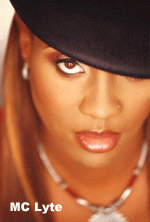
MCLytehat-150Initially I wasn’t gonna weigh in on this, but damn in 2012 and you would think at this point in time folks would know better and do better. Its time to expand our mind and make room for other voices, mainly women in our collective thinking. I don’t know what the process was when RS did the final editing, but no one at that magazine looked at that list and asked ‘Where’s MC Lyte’s ‘Cha Cha Cha‘ or ‘Cappuccino‘? Did anyone at RS bother to check out her site Hip Hop Sisters?

No one at RS or on that panel gave a second thought about Queen Latifah‘s ‘Ladies’ First‘ which featured Monie Love and its impact? No one thought about UNITY…No one? Really? Cmon now..

None of the folks at the panel gave a thought about the 33 songs that were released around the whole Roxanne Roxanne saga? Some of those songs were landmark.  They gave birth to artists like; Sparky D, Roxanne Shante and the Real Roxanne.. None of those women were good enough to be included? There was no room for an artist like YoYo? No Lady of Rage‘s Afro Puffs? No love for Mystic’s ‘The Life’? No choice cuts from Foxy Brown, Eve or Lil Kim made the list?? How is our collective thinking so narrow in 2012?

Luther Campbell of the 2Live Crew was among the panel of experts  that Rollingstone assembled. Did he or anyone mention Anquette‘s Janet Reno? Luke in the past has been very clear to talk about how that song which was done by his cousin helped Reno win an election for DA against a lawyer named Jack Thompson. Luke explained that Thompson became enraged as a result of this and wound up coming after 2Live crew for having obscene material. The case against 2Live crew went all the way to the Supreme Ct.. If one record be the source of all that, should it not be on the RS list?

LaurynHillside

Lauryn Hill

With respect to Lauryn Hill who won more Grammys than many of the artists featured and the experts assembled should’ve been further up the list, like in the top 15 or 20. I would’ve picked Doo Whop (That Thing) which charted on Billboard as number 1 or Everything is Everything..

Considering Rollingstone’s glaring omissions I guess it would be too much to expect them to have even considered a Jean Grae, Bahamadia, Rah Digga, Conscious Daughters or Medusa?

All I can say at this point is to Rollingstone and its panel of experts which included only 2 or 3 women at the most. that was big miss to only have 3 or 4 females on that list of 50 Greatest songs. It was a big miss and just plain wack.. For those who need more info on women making moves.. Here’s playlist I put together earlier this year.

http://www.youtube.com/playlist?list=PL4DA130E1819B4915

http://www.youtube.com/watch?v=qhW_ph0ipp8

http://www.youtube.com/watch?v=f8cHxydDb7o

Niggery: When Will The Buffoonery & Coonery End? by Global Hip Hop Battles

Think Hip HopGlobal Hip Hop Battles, is committed to raising people’s consciousness, by sharing information through our post. Our goal is to empower and challenge the youth, to think far beyond their borders; that are often surrounded with an influx of negative images and messages.

We’ve made it no secret in the past, that we believe hip hop culture and the media, has become one-sided; with respect to messages and images being portrayed.

If you take a look at hip hop and the media twenty-years-ago, you can see there was more balance, in regards to the images and messages being displayed.

Music of this era included artist such as Queen Latifah, and Public Enemy, and Big Daddy Kane, just to name a few.

While, television at the time included shows like The Cosby Show, A Different World, Living Single, and BET’s Teen Summit to name a few.

And while these artist and television shows, were different with respect to their music and programs, they seemed to always be dedicated to making sure they worked to raise peoples consciousness; especially young people.

Fast forward to 2012, and we’re living in a time where the messages and images don’t seem as positive. Instead, the majority of the images and messages seem to be anything, but empowering.

It seems as though we’re living in an era, where mass media floods the market, with a barrage of negative stereotypical images; that work against helping to build and repair urban society.

For example, television shows like Love and Hip Hop Atlanta,as well as several websites, seem to fuel this stereotype, by portraying Black men and women in a very negative light. They seem to perpetuate the pimp and ho’s mentality, by glorifying these images.

Now we’re not saying that television shows and websites  shouldn’t have the right to promote what they desire, we’re simply saying there needs to be more balance, with respect to the images we see. Often times, those negative images have the potential to cloud people’s judgement.

For example, when speaking with a friend, who’s a Black woman, and a business owner, she explained that people expect her to behave like the woman on these reality shows, when brokering business deals. She also indicated that she has to spend time reaffirming herself to potential clients, in order to be taken seriously,during business transactions.

The current cultural climate seems to have accepted this behavior as being normal, which seems to have caused  the respect level for Black men and women, to depreciate greatly.

In addition, many of the current hip hop artist, aren’t helping the matter, using the term bitches and ho’s loosely, and glorifying the pimp culture; to the degree that it’s become apart of the everyday vernacular.

20 years ago, it wasn’t culturally accepted to be a “bitch,”  “pimp,” or a “ho” In fact, many of the artist made the choice to stay away from those stereotypes, to offer an alternative in hopes of empowering Black men and women.

big-Daddy-Kane-ponder-300A prime example is from hip hop legend Big Daddy Kane. During TV One’s Unsung series, Big Daddy Kane said that he wasn’t raised to call women bitches and ho’s, “that’s not the way I was raised, my moms didn’t raise me that way” said Kane.

Therefore, his music encompassed his morals and he refused to waiver. He took responsibility and seemed to approach his position, as an artist with a sense of purpose.

Queen Latifah also made it clear in her 1993 song “Unity” where she spoke out against being disrespected. This seems to have worked to make women demand respect, during times where they felt disrespected.

Somewhere over the past 20 years, however these messages of empowerment, and respect were exchanged for disrespect, and degradation of the Black community.

The portrayal of men and women in hip hop and the media, is just one facet of the issues, another problem seems to be with lack of uplifting and informative messages; both on television and in the music.

While there are a handful of artist, who do concentrate on bringing empowering messages to people. They seem to often be over-shadowed by the negative messages and images.

The iconic hip hop group Public Enemy, spoke out against the injustices plaguing urban communities in songs like “Fight the Power;” which served to raise awareness about these issues.

In 2012, most of these issues remain to be the same, yet few seem bold enough to speak up. Instead, the culture seems to be saturated with messages that only further work to dis-empower people.

An example on television, is BET’s Teen Summit; which was on the air during the 1990′s. Teen Summit, took real Black teenagers, and gave them a forum to address issues including sex, violence in communities, applying to college, and money matters to name a few.

Cosby showIn addition, sitcoms like “The Cosby Show,”  ” A Different World,”  “Living Single,” worked to empower people. For example, many of us who grew up watching “A Different World,” were inspired to attend colleges and universities, as a result. That’s the power great programing can have on people, if  it’s offered.

In 2012, BET does not offer a program that’s dedicated to addressing issues young people face, and giving them information aimed at empowering them. In addition, there are few sitcoms on television, due to the influx of often reckless reality shows.

Now as we stated earlier, we understand that there’s a time and place for everyone and everything, what we are simply saying is, there needs to be better balance with respect to images and messages; if we want to properly move into the future.

Young people are impressionable, and if they are only exposed to poor images, then that’s what they’ll become. We owe it to our communities and ourselves to bring more balanced images to the forefront, and help to empower the youth.

Let’s all make a conscious choice to bring balance to our culture. If you know better, then do better!

Google is gearing up for a debate on hip hop titled versus debate. It’s scheduled to air live online, and will feature the legendary KRS-One, ?uestlove, and Rev. Jesse Jackson, to name a few. In the debate/discussion they will ask the following questions:

Is hip-hop the authentic voice of the oppressed that turns anger into poetry and political action? Or is it a glorification of all that holds back oppressed minorities and hinders them from mainstream assimilation?

source: http://www.globalhiphopbattles.com/news/niggery-when-will-the-buffoonery-coonery-end/

Disturbing NY Post Subway Photo Sets Off Debate..Make Money or Save Lives?

Post photo subway I know I’m not the only one who finds the irony of newspaper outlets like the New York Post that would seemingly rush to license and publish a shocking photo of a man named Ki Suk Han about to get crushed by a subway train, but didn’t seem to eager to go against the Bush imposed media blackout on war casualties in Iraq and Afghanistan.

I guess for the NY Post its ok to shock our senses and maybe get us to debate the journalistic ethics around helping someone in dire straits vs documenting even as danger looms. Imagine if early on the NY Post showed shocking pictures illustrating the horrors of war and set off debates about why we were even in places like Iraq.

Imagine if the NY Post found a way to get photographers to document the day in and day out abuse many NY residents have to endure when they are stopped and frisked by overzealous cops. Can they shock our senses about police abuse or corruption?  Apparently not..

In the back drop of all this is the FCC led by Obama appointee  and current chair, Julius Genachowski seems to be down to loosen up the rules that would allow Post owner Rupert Murdoch to buy the Chicago Tribune and the LA Times..That would allow Murdoch to run shocking pictures in those outlets while remaining silent on war casualties.

As for the photographer R. Umar Abbasi after seeing his interview on the Today Show where he explained he was nowhere near the man to help him, I just didn’t buy it..His attitude and subsequent actions seemed more interested in a payday based on death vs saving a life or at least trying..

His attitude seems to be of the same vein of far too many who will close their doors and button up the hatches vs extend a helping hand. We saw a lot of that during Katrina. Heck we just saw that during Hurricane Sandy where a woman went door to door with her two kids trying to avoid flood waters. People refused to help her or open their doors and hearts to her frantic screams even as her kids were swept away to their death by the rushing waters.

The NY Post picture in my humble opinion represents our collective devaluing of life and another step away from our humanity


Police Say Handcuffed high school student shot himself in back of police car

Police--fight-back-blueThis is the second time this year a man who was handcuffed and put in a squad car shot himself..Earlier this year we had a young man by the name of Chavis Carter, 21 who was accused of committed suicide even though he was handcuffed from behind and had been searched twice for weapons. He had been picked up by authorities during a traffic stop in Jonesboro, Ark.

In this new incident which took place in Houston, Tx…Police said, a 17 year old high school student hid a gun that police didn’t detect it…. He some how got a hold of it and shot himself..Wow.. just wow..

You can read the full story HERE

http://nbcnews.to/RCN1mW


The War on Women: Remember their Names.. Reflect on their Lives… Revolutionize

black-woman

The War on Women Continues: This morning I woke up to disturbing news about a woman who was shot to death while riding her bike near Longfellow school in Berkeley. I’m not sure why she was killed nor do I know her name but what immediately came to mind were the two teenage girls, Bobbie Sartain and her best friend Raquel Gerstel shot over 40 times in Oakland the other week…

What also came to mind was the recent kidnap and sexual assault of an 16-year-old autistic girl, with the mental capacity of a 6 year old. She got separated from her youth facility in East Oakland and was preyed upon by a man who kept her in bondage for 3 days.. Police eventually caught up with 36-year-old  Gary Steven Atkinson, who was long known to be a predator…But the damage is done. Trauma has been inflicted..

All this is compounded by a wave of assaults both within and outside the borders of our city. They range from the recent shooting death of a unidentified woman in Fruitvale 10 days ago, to an attempt by a young man in Fremont, (Cali) to hang his girlfriend in his backyard after an argument,  to shooting death of 25 year old Samantha Holderman of Antioch (Cali ) to a man who beat his wife to death in Staten Island, NY,  before taking his own life.  I can go on and on listing atrocities.

Locally all that I mentioned is underscored recent Facebook status update of long time Oakland activist and mother Needa Bee who posted up a warning about ” a psycho raping and torturing women at gunpoint in Funktown (East Oakland) . Homeless, hookers, crackheads. 2 of the women have gone to the police. And the police have done nothing“. Needa recently update us to note that word on the street is there is some sort of pimp war going on resulting in these men shooting and trying to take out each others girls..Femicide on a whole other level.

Needa Bee’s warnings are frightening because not only have the police been absent but not too many of us in the community are speaking on what she reported, but then again many of us are pretty silent on the two girls shot 40 times..Very few of us are asking and how and why? …Sadly, not a whole lot of us are talking about Kasandra Perkins, a young mother shot 9 times in front of her 3 month old child and his own mother…No one is talking about the fact that Kasandra may have been pregnant again…

Kesandra perkins

Kesandra Perkins

What we are talking about is Jovan Belcher, the Kansas City Chief football star who killed his girlfriend Kasandra and later himself in front of his coaches. What we are talking about his how the KC Chiefs demonstrated ‘inspiring courage‘ and how they ‘played valiantly‘ less than 24 hours after this horrific tragedy…Far too many of us were quoting media talking points about how the Chief’s win was a triumph and start the “healing process

Personally I thought it was in bad taste for the NFL to have allowed that game to be played. I don’t know if any sort of healing was really started.. If anything, I think it prolonged our collective silence.. The least we can do is shed light on the victims and remember their names…

We should also not numb or allow ourselves to be distracted from these recent assaults. They should weigh heavily on our hearts and minds and move us to find ways to end violence against women. Anything less is an indication that we are stepping away from our humanity.

Remember, Reflect, and Revolutionize

Answering Bougie Black Girl’s Blog on Arab Racism Against Blacks

This is a dope article.. that addresses the issue of Black / Arab relations ships..