Casual of Hiero Weighs in on Museum Controversy….Furious Styles is a Jerk.

Casual of Hiero Weighs in on Museum Controversy

I also applaud the people working with the development of the new Bronx museum. I really think its important in telling the story of Hip Hop aswell. I also think that Furious Styles is a Jerk.


(Casual is referring to the article we passed around earlier which is located here:
http://p076.ezboard.com/fpoliticalpalacefrm73.showMessage?topicID=20.topic

casual-HieroTo support the exclusion of Gangsta rap from a hip hop museum is like the act of excluding the mention of African Americans in the development process of America. His erroneous assessment of “gansta music” further proves his disconnection from our society. He is like a outsider looking in. “Gangsta Music” is the opposite side of the spectrum. The Yang to our Yin. A Museum with no mention of gangsta rap will receive no merit. Not even a room?.. a wall? Gangsta rap is the fuel pushing hip hop to the front of main stream music, It has enveloped and eclipsed your traditional “Positive Hip HOP” for many reasons, the main reason being,.. The aloof attitude of the positive hip-hopper.

Positive Hip Hoppers(for lack of a better term)or should I say hip hop optimist can always point you to a time when hip hop was better, more meaningful, and artist were more positive.
But truly there was no time like this, and if there was, it didnt last long. There is no evidence that there is more gangsta rap now than there was in the 1980. (And for any hip hop historian who wants to debate this,.. We can go song for song.)But there is evidence that gangsta rap has grown into a more lucrative commerce than “Artsy Rap”.

Here is a point I would like to make. Furious Styles shares the views of most Upper Middle Class, American-College educated Black Men. This problem you have with Gangsta rap mirrors the problem you have with the lower classes of society, your own Race, even your own less accomplished family members. This is western philosophy at its best. Bottom line is-you feel you are better than the people who achieved less. Do you believe the persons singing about Murder, Guns, Drugs, Sex, Mayhem, etc,. has know place in a museum of Hip Hop History?. You want to shelter you children from this awful exposure to reality like your hiding porn. But the truth is,… N.W.A. Can save your daughters life, So Can Justice-Ice, KRS-One, Tupac, Ice Cube and even listening to Too-Short Can Help your Daughters with their street smarts. And here is a quote for Furious Styles to further expose his insensitivity to your struggles;

I understand the age old worn out statement that Gansta Hip Hop is a product of the environment, its bigger than the thugs, pimps and playas, we dont own the planes that bring drugs into our communities, the-had- a- bad up bringing, no daddy in the house, being shot, the streets, etc. etc. etc.. etc.. But the fact of the matter is that these artists are pushing stripper music into the ears of our children, they are talking about crack selling, distribution, and murder, and wonder why we have so much violence in the lives of our youth.- Furious Styles

What is your major malfunction? Do you think living with no dad helps? Or being shot? Or having a bad upbringing? Surely your dad was there, you never been shot, and you had a good upbringing, that is why you are so insensitive to others reality. Your like a inconsiderate bitch.

And SO IS THIS WHY WE HAVE SO MUCH VIOLENCE? IS GANGSTA RAP THE REASON WERE IN IRAO OR AFGANISTAN? DID GANGSTA RAP PLAY A PART IN COLOMBINE OR WAKO? GANSTA RAP SURELY DIDNT BRING DOWN THE WORLD TRADE CENTER DID IT? AND IM SURE BLACK WALL STREET AND HEZBOLLAH HAVE SOME SORT OF CONNECTION?

And whos the Judge?

Is K.R.S.-One not a Gangsta? Did he release a album called Criminal Minded? Did he tote a Uzi On the cover of “My Philosophy?” Or is he afforded a period of time to change his views that now young artist wont be allowed?

Will Ice Cube Be in your Museum? He is definitely one of the most positive Artist to Date, Yet he grew from this most awful Gangsta rap, Bitches, Hoes etc…. Shall his efforts be slighted by your Museum?

On the other Hand Tupac? was he positive or a optimist or just a Soft Thug? who’s the person to say that a particular song or artist has know purpose universally?

Go ahead and build your little “Twinkle Toes” hip hop museum and “Georgie your own wee-wee”, But the truth is, The more divisions we place, the smaller each category gets, and leaving gangsta rap out of a hip hop museum confirms your intend to lie to your children, and your successors.

P.S. All of my releases have been positive by your standard,..bet i wont be in that bitch either,… some museum.

Casual of Hieroglyphics

Return to Davey D’s Hip Hop Corner

I Say Let them (Gangsta Rappers) Get There Own Museum

This article is in response to the recent controversy that emerged around the new Hip Hop Museum in New York. The city council which funded part of the museum is insisting that gangsta rap not be aprt of the exhibit. Here’s the article..
p076.ezboard.com/fpolitic…D=16.topic

I say Let them Get There Own Museum.
by Furious Styles

I applaud the people working with the development of the new Bronx museum. I really think its important in telling the story of Hip Hop, that we leave something for future generations to be proud of and to strive for. I believe wanting to be an emcee and to rock a party or have a good time, or to talk about yourself and how fly you are, or cleverly showing your battle ability without degrading people because of your lack of vocabulary, or talking about women and relationships in a nurturing and healthy way, or various societal issues is great. If you are a history of music, these songs with these topics and mood from the 60s and 70s are considered classics, and stand the test of time no matter what new microwave pop corn new act that pops up. Examples- Chage Gonna Come- Sam Cooke, Whats Going On- Marvin Gaye, Sweet Thing Chaka Khan.

But when you begin talking about or glorifying death, murder, mayhem, pimping, misogyny, incest, guns, cocaine, women as objects to just dance, or portray black people, or the Hip Hop generation as a group of people who live in the club, @#%$, fight, drink, steal, or do anything counterproductive to life, I feel firmly that you have no place in a museum, or in the history of Hip Hop, except in showing what was wrong with our culture, and how we should never have future generations go down that road but learn the lessons of history.

I understand the age old worn out statement that Gansta Hip Hop is a product of the environment, its bigger than the thugs, pimps and playas, we dont own the planes that bring drugs into our communities, the-had- a- bad up bringing, no daddy in the house, being shot, the streets, etc. etc. etc.. etc.. But the fact of the matter is that these artists are pushing stripper music into the ears of our children, they are talking about crack selling, distribution, and murder, and wonder why we have so much violence in the lives of our youth. Oh, by the way, what you listen to does make a difference on your psyche, mental health, self impression, everything. . Check out the movie where the dude at McDonalds for a month. If music is food, and you are what you eatThink about it.

If gangstas, pimps, playas, hustlas, tricks, ballers, killers, rapist, murderers, foul mouth imdividuals want a museum to display their works, let them build there own. But for me, I want my kids to take their kids to a museum where they can learn the importance of all the men and women on stage and behind the scenes that made Hip Hop music that had something to say, something to evoke and stimulate thought about life, family, the world, having fun, etc. And I hope my childrens children dont have to go somewhere where they have a Shrine for Nelly but none for Kool Herc, where theres the new track with Trina dissing Khia, but no ladies first by Queen Latifah, where there will be walls of shots of 50 cent, but no remembrance or understanding of Tupac. And yeah, Tupac would be in my museum and 50 wouldnt.

Again, for those of you who may have missed it, read the last 3 lines of the first paragraph. At least with Tupac he was well rounded, and had different dimensions to himself, and was able to challenge himself to talk about more than the bullshit. Most of these new dudes have no reference to Hip Hop history, and have nothing else to talk about. And great artists who have wonderful things to add in the world of music are labeled underground, cant get radio of video play, and are forced to watch people be destroyed for the lack of good musical food. Yeah I said it.

_Furious Styles

Return to Davey D’s Hip Hop Corner

X-Clan Urges People to Boycott World Trade Movie

BOYCOTT THIS MOVIE!!! EMAIL THIS TO YOUR ENTIRE LIST:

9-11areialview

It’s so natural for Hollywood to assume that every Hero is a White man.

by DJ Paradise Gray

Hollywood has always changed facts and edited history. From Charlton Heston
as Moses and Elizabeth Taylor as Cleopatra. They are only continuing their
tradition of White-washing our history. If they were able to portray Imhotep
(The Mummy and The Mummy Returns who was one of the greatest black Heroes of
all times and Jesus Christ as white without a single peep from our
community, why should this even matter to them in the least?

Situations like this will continue and we as Black people (or whatever you
want to consider yourself) will deserve what we get, unless we are willing
to stand up against tyranny and white supremacy.

Demand that this movie be taken out of theatures. Boycott this movie like
they attempted to boycott “Barbershop” show some community outrage like they
did for the poster of 50’s Get Rich Or Die trying. Cause the national media
to pick up this story.

Do something for a change. (Yes I’m talking to you!).

Paradise Gray
http://www.myspace.com/paradisegray
(Please forward to everyone on your email list, as the national press has
not or will not pick up this story)

Full story in The New Pittsburgh Courier
http://newpittsburghcourieronline.com/articlelive/articles/35730/1/World-Trade-Center-omits-Black-soldier/WTC-movies-unsung-hero.html

‘World Trade Center‘ omits Black Soldier

Following disasters of historically epic proportions like the attack on the
World Trade Center, there are bound to be countless tales of self-sacrifice,
heroism and triumph. Some stories, like those told in the movies Flight 93
and Oliver Stone’s World Trade Center, premiering Aug. 9, are made into
blockbusters for the world to see. Others are either whispered quietly among
family and friends or confined to the memories and souls of those who refuse
to speak of them.

Such is the tale of United States Marine Corps Sgt. Jason L. Thomas–in
spite of the fact that his story and the one told in World Trade Center are
one in the same.

THE STORY

The morning of Sept. 11, 2001 began like any other for Jason L. Thomas. A
student at the John Jay College of Criminal Justice of City University of
New York, he heard about the attack after taking his daughter to his
mother’s house in Queens so he could attend classes.

At the time I was saying to myself, That’s an attack. My mother looked at it
as if it was an accident, but one of the first things that came to my mind
was, They got us, he said.

Immediately after that, I just got in high gear. I had my uniform in my car,
my C-Bag. We just moved into a house, so I had a lot of my personal
equipment in my vehicle. I ran out to my car, got my uniform, got dressed
and shot to the city.

After a delay in Queens, which Thomas credits for keeping him away from the
collapse of the South Tower, he attached himself to a police convoy and made
it to the site within moments of the fall of the North Tower.

Approaching one of the towers, all I see is one at the time, I see the
building come crashing down. It just comes straight down. I park my vehicle
and I remember this cloud of smoke and ash just enveloped where I was. I
stuck my head down in my shirt and scooted behind my car and got on my
knees, but it engulfed the area. So I got up and I just ran in the direction
towards Ground Zero.

At Ground Zero, Thomas immediately began to help by fighting fires,
establishing triage sites to help the injured and assisting with the overall
evacuation. While his primary focus was devoted to the emergency, he
couldn’t help being affected by what had become of his city.

I know this beautiful city, and now here it is, it’s just rubble, he said.
There are fire engines on fire, and you don’t see that everyday–you don’t
see cars and ambulances on fire. I was just trying to take it in.

After hours of firefighting, assisting survivors and in some cases, praying
over the dead, Thomas ran into another marine, Staff Sgt. Dave Karnes.
Thomas presented a plan for a search and rescue mission of the area and he
and Karnes tried to enlist other soldiers on site to help. When they were
told the mission was too dangerous, they decided to go by themselves.

I found a couple guys, but it wasn’t enough, to them, to start a search and
rescue, he said. I remember myself and staff Sgt. Karnes saying, We’re going
to start the search and rescue with or without you, because someone needs
us.

THE MOVIE

The World Trade Center movie tells the story of the rescues of New York Port
Authority police officers John McLoughlin and Will Jimeno from Ground Zero,
as well as that of the men who rescued them. In real life, the officers were
rescued by sergeants Karnes and Thomas. In the film, however, they were
rescued by Karnes and PFC Dave Thomas; a composite character, played by
William Mapother, a white actor, who is meant to represent Thomas.

World Trade Center producer Michael Shamberg said that they knew about Sgt.
Thomas’s role in the rescue, but were unable to find him when creating the
film. He said producers didn’t discover Thomas was a Black man until after
they had started the movie. He also said that in spite of the fact that the
film was co-written by McLoughlin and Jimeno was consulted for authenticity,
no one ever asked them for a physical description of the man who helped save
their lives.

Frankly, we goofed–we learned when we were filming that he was an
African-American, said Shamberg. We would change it if we could. I actually
called him and apologized, and he said he didn’t mind. He was very gracious
about it.

Shamberg also apologized for another African-American officer, Bruce
Reynolds, who was also portrayed as white in the movie.

Thomas, meanwhile, didn’t learn the film was about his story until he saw
the unmistakable image of two marines peering into a whole at Ground Zero
during a commercial for the movie. He said that while he wasn’t angry about
how the film turned out, he does wish it could have been more realistic.

Full story in The New Pittsburgh Courier
http://newpittsburghcourieronline.com/articlelive/articles/35730/1/World-Trade-Center-omits-Black-soldier/WTC-movies-unsung-hero.html

———————————————————————————————–
Paradise Gray
Honorary Chairman, Pittsburgh LOC
National Political Hip-hop Convention
Grand Arkitech Of The BlackWatch Movement
Minister Of Arts And Sciences Millions More Movement
Director Of Almost Home Youth Ministries
One Hood
Http://www.myspace.com/paradisegray

Return to Davey D’s Hip Hop Corner

Is Busta on Steroids? Beating Victims Speaks Out


Is Busta on Steroids? Beating Victims Speaks Out

A while back we ran an interview with former Source owners Dave Mays & Benzino shortly after Busta and Mays had their altercation in Miami. The end result was Mays getting hit upside the head with a bottle and having to get stitches. Benzino alluded to the fact that Busta was on steroids and needed to check himself. At first many of us laughed it off and attributed the remarks to a jealous Benzino, but in lieu of this latest altercation, one can’t be too sure.. What’s really going on?

Beating victim recounts rappers rampage,
BY NICOLE BODE and ALISON GENDAR
DAILY NEWS STAFF WRITERS
playahata.com/hatablog/?p=1801#more-1801

Busta Rhymes

Busta Rhymes

Busta Rhyme victim was a former fan and plans to file a civil lawsuit after the teen suffered a concussion and a split lip. His violent unprovoked account gives credence to rumors of steroid rage. (This sounds more legitimate than Buster Rhymes story.)

One moment, Roberto Lebron was telling Busta Rhymes he was a big fan – and the next thing he knew, the rapper was kicking him in the face.
That was the dramatic account offered yesterday by the 19-year-old Bronx man, whose allegations of a Chelsea beat-down landed Rhymes in his latest scrape with the law.

While I was on the ground, he was kicking me in the face, Lebron said yesterday. I saw him kick me.
Lebrons crime, he said, was accidentally spitting on Bustas ride on Aug. 12.

Me and my friends were walking across the street. I spit on the street and it landed on a moving car. It was a Maybach. That car stopped, along with two black SUVs.

People came out and they were walking up to me. We realized it was Busta Rhymes, Lebron said in a phone interview arranged by his lawyer.

He asked me, Homie, did you spit on my car? I said Sorry, I didnt mean to. Were big fans of yours. That was the last thing I said, Lebron recalled.

One of his people hit me in the face and I fell on the ground – and then Rhymes came over to finish the job, he said.

Lebron said the star and his crew kicked and punched him in the middle of Sixth Ave. near 19th St. – then yanked his Nike sneakers off his feet and tossed them away.

Rhymes beefy posse kept Lebrons three friends from coming to his aid, and bolted after about two minutes, he said.

I guess they got tired of beating me up, said Lebron, who was a student at John Jay College of Criminal Justice until he took a full-time job hooking up televisions in hospital rooms.

Lebron filed a formal criminal complaint on Saturday, and cops busted Rhymes after his concert at Randalls Island.

Here’s a response from my man C Wise regarding that question…

I keep telling folks this is a mid-life/end of career crisis this man is going through. I’m not a doctor nor do I claim to be one, but Busta’s behavior over the past year has drawn those to believe he’s suffering from roid rage. He’s been in some many different altercations, even with a security detail, Busta seems to find himself drawn into these conflicts, some of which sound like they can be avoided by just walking away.

Is it Steroids? I don’t know and I don’t want to be the one to ask either.

After learning more about what happened to Proof back in April, it made me realize that black men seem to be the ones killing each other more and more everyday. We are often thrown in to situations that can result in violence. I’m not trying to rip off the Boondocks, but lately Busta is making headlines for various “Nigga Moments”, and I’m afraid the pattern he is following may result in us saying another RIP to another Hip-Hop legend. :|

Return to Davey D’s Hip Hop Corner

Take Back America- Davey D Confrontation with Fox News

Take Back America- Davey D Confrontation with Fox News

By Paradise Gray

This years “Take Back America Conference” in Washington D.C was much more exciting and energetic than the one I attended just a year ago. There were more young people of color present and everyone seemed to have extra pep in their step. I began the weekend with The League of Young Voters, taking their empowering “Tunnel Building” leadership training program at the offices of The People For The American Way. The training sessions were good, and included veteren and aspiring organizers from all across America, some as young as 17 years old.

The new National Director of the League Rob “Biko” Baker and National Political Director Khari Mosley handled many of the training workshops personally. It was a pleasure to work with these brothers and I learned some great new ideas and concepts to use for organizing effective actions and successful campaigns. I was happy to contribute by helping to teach a workshop on using new media and the internet (Myspace and Facebook) as organizing tools.

On Monday March 17th we headed over to the The Omni Shoreham Hotel where Van Jones the President and founder of “Green For All” brought the heat to the Take Back America Conference at this morning. Speaking to an overflowing room full of progressive Democrats Mr. Jones passionately explained the benefits of an emerging Green Economy. His inspiring speech informed the diverse crowd about policies and initiatives that could create jobs, efficient energy, reduce carbon emissions and improve local economies.
Mr. Jones received thunderous applause when he noted that by retrofitting American cities with renewable energy sources such as wind, solar panels and other alternate sustainable energy sources it would ensure that we would never have to wage war for oil again!

In the crowd I noticed the Reverend Jessie Jackson, Davey D as well as members of The League Of Young Voters, One HOOD, the National Political Hip-hop Convention, Reverend Yearwood and The Hip-hop Caucus and members of The Gathering.

Keep your eyes on Van Jones and the concept of a Green Economy and Green-Collar Jobs. Van Jones is a dynamic speaker with a great plan, his final words “I am not here to “Take America Back, I’m here to take it forward” connected and resonated well with this large progressive crowd.

Things got kind of heated on Tuesday morning March 18 when the Rev.Jessie Jackson was scheduled speak on a panel “Progressive Movement In A Democratic Era: The Lessons Of King And The Civil Rights Movement“.
The energy was already elevated as everyone was anxiously awaiting 10:30 when Barack Obama was scheduled to give his historic speech on race relations in America. As I approached the Regency Ballroom I noticed the Rev.Jessie Jackson being interviewed by Griff Jenkins from Fox News. Griff Jenkins was being very aggressive as he demanded that Rev. Jackson answer the question: “Do you or do you not condemn Barack Obama’s former Pastor Rev. Wright?”

Rev. Jackson refused to answer in the way that Jenkins was asking, Rev. Jackson accused Mr. Jenkins of using divisive tactics instead of covering the issues that are important in this election, Mr. Jenkins would rudely push his microphone towards Rev. Jackson’s face and reiterate “Do you or do you not condemn Rev.Wright?”

I did not appreciate the way Mr. Jenkins was treating Rev. Jackson and loudly voiced my opinion as Rev. Jackson, annoyed by Mr. Jenkins unprofessionalism, walked away. Mr. Jenkins then interviewed me and and when posed with the same question of whether or not I condemned Rev.Wright, I responded that when your face down in a mud puddle with someone’s foot on the back of your neck, you should not be judged by the words that come out of your mouth at that moment, anger is the appropriate natural human response to oppression!

I argued that Rev. Wright’s sermons were based on real feelings within the black community and had foundations in fire and brimstone preaching directly from the bible. Mr. Jenkins attempted to cut me off in the middle of sentences but I continued that I could quote him hundreds of statements from the bible that he would not agree with and he would not even recognize that I was quoting the bible unless I told him in advance.

I questioned Mr. Jenkins about why he was interogatting Rev. Jackson so hard when Barack Obama would be addressing the situation himself in less than 2 hours, I suggested that Mr. Jenkins that we should all wait until we have given Senator Obama the opportunity to address it personally before we form our opinions.

I guess that wasn’t enough for Griff Jenkins because as soon as the panel was over, his FOX News TV crew pushed past other journalists on the stage who were asking Rev. Jackson questions about the 5th Anniversary of the start of the war in Iraq. Davey D happened to be one of the journalists who was patently waiting for his turn to ask Rev. Jackson some questions, when Griff Jenkins barged in and started dominating the conversation, repeatedly demanding Rev. Jackson to answer, and diverting from the questions that others were asking about the war.

Davey had seen and heard enough, he began asking Griff Jenkins why are you here? Aggressively pushing his mic in Griff Jenkins face as he had done Rev.Jackson, and stepping in front of a retreating Griff Jenkins asking, ‘why are you here?’

Davey encouraged others to flip the script on aggressive TV reporters that come in and try to set a tone that is contrary to the way that you are coming from, “you have a right to stop them from dominating the conversation and regain control. Fox News has declared war on people of color and puts them in a defensive position, not given them a fair chance to answer back to salacious charges and assertions. They have one-sided conversations by asking you questions and cutting you off before you have a chance to answer them. Fox News creates an agenda and then places people of color within that framework to underscore what they are trying to say”.

Davey D said that what they tried to do to Rev. Jessie Jackson was a perfect example of “ambushing someone with the cameras” they kept asking Rev. Jackson over and over “why don’t you denounce Rev. Wright?… And as Rev. Jackson tried to answer they would interrupt him with “why don’t you denounce Rev. Wright?”

Davey D thought that it was disrespectful, not as much towards Rev. Jackson (who Davey says can handle himself) as much as it is towards millions of people who can discern what is outrageous or offensive on their own without aid from someone who doesn’t go to the church so they don’t know how to put things in the proper context. Here is online video of the incident: (from FOX News)

http://www.dailymotion.com/swf/x4rznd

written by paradise Gray
Foxguy
by luvnews


Are Boys In The Hood Really The New Terrorists? Pt II

The Demonstrations in Pompano Beach Against Moooslims And The Growing Divide Influenced By The War on Terror

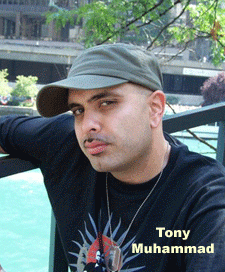
By Bro. Tony Muhammad

www.uannetwork.com

tony muhammed In late June, seven Black men (nick-named The Liberty Seven) were seized and arrested by Federal Agents (6 of them in Miamis Liberty City section) on the grounds of what the community believes to be a case of entrapment led on by an FBI agent who reportedly had the men swear allegiance to Al-Qaeda and commit to the bombing of several FBI offices and the Sears building in Chicago. Partly considering what was making nation-wide headlines at that very moment (The New York Times breaking the story that the Bush Administration has been unconstitutionally spying on millions of peoples financial records), the community regarded the incident as a Weapon of Mass Distractions.

Weeks later, in Broward Countys Pompano Beach, pastor of the Worldwide Christian Center, Rev. O’Neal Dozier, led his congregation to demonstrate in front of City Hall against ”Moooslims” (Muslims expressed in a derogatory manner) that are in the process of building a new mosque in the Black community. The demonstrations came after Dozier made comments against Islam in a news release and on a radio talk show; prompting Governor Jeb Bushs office to ask the minister/lawyer to resign from his post on the Broward Judicial Nominating Committee which he had held since 2001. Dozier, who as a Black Republican has worked closely with Governor Jeb Bush and Attorney General Charlie Crist in recruiting Blacks into the GOP, submitted his letter of resignation on Sunday, June 9th.

Dozier commented to Urban America Newspaper, We can not allow a mosque to be built in a Black Christian community, which would turn our young Black men, who are angry at white people, towards a dangerous religion. When questioned why he regarded Islam a dangerous religion, the pastor asserted that he holds a bachelors degree in religion and philosophy and argued that Islam has a violent history. He argued that the religion itself breeds terrorism. The Pastor was asked if he did not feel Christianity has had its share of violence being committed under its name, especially towards African peoples who were brought into this country against their will and for centuries lynched by their white Christian brothers. Opposing the hard realities of history, Dozier firmly said No, making a distinction that lynchings were not committed under Christianity despite the Ku Klux Klan historically using the burning cross as a traditional trademark symbol. He denied that his concerns have come in response to the arrest of the Liberty City Seven, but made it more apparent by his high emotionalism that he was upset that Islam is in fact the fastest growing religion among Black males in the United States. When asked if he has sat down to talk with Altaf Ali, the executive director the Florida chapter the Council on American-Islamic Relations, and others responsible for the building of the new mosque, Dozier responded in an restless tone, Why should I sit down with them? I know how they feel! I know their religion! I know its origins! They want to kill everyone! Dozier, who has made recommendations to the Bush administration about combining faith-based initiatives with combating HIV/AIDS in Africa, ended the interview by expressing awkwardly, I love the Muslim people. They are victims because they are misguided. They need to receive Jesus Christ as their Lord and Savior. Dozier affirmed that his opposing the creation of the new mosque has not ended; stressing, We will fight until we get results, including the courts if we have to go that rout.

Concerned about the conflicts and misinformation that could potentially spawn as a result of Doziers message regarding the effect of Islam on young Black men, the Fort Lauderdale based Muhammads Mosque #82 of the Nation of Islam has sought to inform the Black community in Pompano the truth behind the religion and its principles. Minister Ronald Muhammad commented to Urban America Newspaper, The Nation of Islam is definitely comprised of Muslims and have many mosques in the Black community, just as our Arab brothers who also have many mosques in the Black community. Muhammad adds, There is no record of violence or negative effect in the Black community as of consequence. Islam is a reforming religion, Muhammad asserts, I dont know where he (Dozier) is basing his argument but history does not support his argument. Critical of Doziers actions while involved in the Broward Judicial Nominating Committee and currently as a pastor, Muhammad argues, Social, civic and religious leaders have a moral responsibility to take a position that represents the general well being and edification of the people that they serve as it relates to the laws and rules that they serve. Muhammad concludes, In any civil society, freedom, justice and equality for all overrides any personal disposition that a public figure may have.

Urban America Newspaper contacted the Pompano Islamic Center for commentary. After greeting a representative on the phone with the traditional salutation of peace for the Muslim world, As-Salaam-Alaikum, and explaining the purpose of the call, the representative who remained unidentified responded with an emotional rant, WHO IS THIS? WHAT IS THIS?

The response is symbolically reflective of the level of distrust that many Muslims and conscientious people have developed for each other since President George W. Bushs War on Terror began in September 2001. Since it has been clear that the Bush administration has been (both legally and illegally) investigating the phone conversations and financial records of millions of people in America, many such people have been limiting the type of conversations they would have over the phone, through e-mail or even in person. Even more obvious, soon after the seizure of the Liberty Seven, various Sunni Muslim organizations nation-wide issued public statements about how those who were involved in the group were not really Muslims and were in no way related to them or their religion, an act that violates the principles of the Islam. Instead of working to gain justice for those are very obviously victims of the system, they step away in fear that one day they will possibly become victims in a similar manner. What is clear is that The War on Terror has played a strong part in increasingly dividing up segments of America who suffer from the same problems; both between communities and within the same community.

Return to Davey D’s Hip Hop Corner


The Return of LA Hip Hop… Blu is in the Building

Whoever said Hip Hop was dead, obviously had not peeped Blu, a South Central LA native who defies any and all stereotypes we like to associate with cats from the hood and West Coast emcees.

For starters we have to take special note to the way the tall lanky emcee spells his name. There is no ‘E’ at the end and its a oversight that he often rhymes about. Second, Blu got hip to Hip Hop late in life. He is the stepson of a strict pastor who forbade him from listening to Hip Hop while he was growing up. His biological father is a member of the Bloods who listens to gangsta and Bay Area turf raps. To this day Blu’s dad calls him him ‘Flu’ instead of Blu. Thats how deep it gets.

According to Blu, he got turned onto groups like De La Soul only after hearing DMX. His musical upbringing and ultimate influences before being introduced to Hip Hop was centered around a diverse collection of artists ranging from Al Green to Thelonious Monk to Bob Dillon. It’s no mistake that the lead song off his ‘Below the Heavens‘ album is a remake of the Del’s classic ‘My World is…

Blu says he regrets missing the Golden era of LA Hip Hop which was personified by legendary spots like the Good Life and Hip Hop staples like Freestyle Fellowship, Jurassic 5, Project Blowed and the late Bigga B to name a few. However there’s no denying that his lyrical prowess and charismatic style kicks in where those legends left off.

Blu acknowledges that it was people like Charli2na of the J5 who sat him down and laced him up with lots of info and tales surrounding the scene of that bygone era. Much of what 2na told him was underscored by radio shows like The Wake Up Show and Friday Nite Flavas before it was unceramoniously taken off the air.

As Blu honed his emcee skills he cites Inspectah Deck of the Wu-Tang Clan, LA legend Cashus King and Planet Asia as being big influences. With respect to Deck, Blu says that he’s the illest emceee when it comes to kicking off a song. He cites the track Triumph as the one where Deck truly shines. Blu’s one regret with the new debut album ‘Below the Heavens‘ was not having Deck on. However when peeping songs like ‘Simply Amazing‘ you can clearly hear how he was inspired.

During our interview in which Blu walked us through a variety of songs including ‘Narrow Path‘, ‘Simply Amazing‘, ‘Show Me the Good Life‘ featuring singer Aloe Blacc of the Dirty Science Crew and ‘Bullet through Me‘ off an upcoming album called ‘Piece Talks‘, he admits that he has a lot to say and his feverishly working to put out 6 different projects which will allow him to get everything off his chest. He refuses to be limited by industry driven categories and limitations.

For example, in the song ‘Bullet Through Me‘ which is off the Piece Talks album produced by Ta’arach, Blu does an experimental cover of a Paul McCarthy song. He admits that upon first listens many will question where he is going and what he’s doing, but folks will learn to get passed any hesitations. His ultimate goal is to put fun back into Hip Hop and be creative. He also wants to help bring national attention back to LA and west coast Hip Hop. In 2008 where everyone is talking about Change, Blu’s attitude and outlook is right in step. This looks to be a big year for him.

by Davey D

You can peep the Blu interview on Breakdown FM by clicking the link below

Meet the Godmother of LA Hip Hop-Medusa the Gangsta Goddess

Every once in a while I feel compelled to do my duty as a productive citizen and generously give back to the community. Sometimes I volunteer my time. Other times I give money. Still on other occasions I give sound advice. Today I wanna take some time out and give some sound advice to anybody who is an aspiring artist as well as to those who have been around the block a few times.

My heartfelt advice to you is as follows; If you happen to be booked for a show and the promoter has you coming on AFTER this LA based artist named MedusaDO NOT DO IT. Have your manager re-negotiate your contract, but do not go on stage right after her. You may be able to get by if they let the deejay play an hour long set or something or you have an artist like KRS-One performing alongside you… Maybe if you’re a bit sadistic and like pain then following Medusa might be the thing for you to do. This woman is not to be followed.

Check our Breakdown FM Intv w/ Medusa

If you are a battle emcee who has won a few contests and you’re feeling good about yourself and your looking for new challenges-Be warned! DO NOT set your sites on Medusa. Don’t let your homies or an over ambitious promoter set you up.

If you find yourself on the bill and they schedule you to go one on one with her, the best thing for you to do is call in sick. Go on vacation.. leave the building. A true friend does not let their good friends get in the ring and trade lyrical jabs with Medusa. She will cause you extreme embarrassment, lots of pain and is likely to end your career if its in front of a large crowd. This woman who is often dubbed the Angela Davis of Rap or the High Priestess is no joke. Please Believe that.

When we look back on Hip Hop history one name that we simply will not be allowed to ignore is the Gangsta Goddess, The Angela Davis of Rap, the Top Cat of the clique Feline Science, the Godmother of West coast Hip Hop-the High priestess-Bow down to the one and only Medusa.

Most people know Medusa the ‘Top Cat’ of the clique Feline Science as colorful engaging pioneering sista who has been rocking packed houses here on the west coast for the past 15 years. This skilled emcee hails from the legendary night spot-The Good Life Cafe which gave birth to legendary groups like Jurassic 5, Freestyle Fellowship, Volume 10, Kurupt, WC and many many more. Anybody who was anybody paid their dues at the Good Life back during LA’s Golden Era of Hip Hop in the late 80s/early 90s

http://www.youtube.com/watch?v=rQAKXrJ5N5k&feature=relmfu

Medusa was a regular to this haunt and later Project Blowed, where she not only held her own but would routinely surpass her male counterparts. As she explained during our recent sit down, that there were many a days she had to step into the arena and battle her Good Life comrads.

One memorable bout involved Peace from Freestyle Fellowship who she took out during a Source Magazine battle at the House of Blues. Many who know Medusa and hear about her past wins are not surprised, this is a woman who once she gets on stage -all eyez on her and you can feel her energy down to the core. Like I said before, if you can beat a cat like Peace or even just hang with him, then you are truly-no joke…

Medusa has always been known as a cutting edge, fierce emcee who is always willing to push the envelope. This was best illustrated on another memorable evening when she first performed what is now her signature song. ‘Power to the P’ is a spoken word piece that pays tribute to the female’s private parts. Medusa wanted to see how far she could go in terms of kicking up dust while adhering to the Good Life’s strict ‘no cursing’ policy. She laughingly recalled how it shocked everyone senses because it was very descriptive, very provocative and yet still ‘clean’.

“It took a minute before everyone realized what I was doing. Once people caught they started cheering and flicking their lighters”, Medusa noted. She said the sexually suggestive content prompted the owner B Hall to rise up and make her stop but that brief performance got everyone talking to this day.

Long before many groups were on the scene with a live band Medusa and Feline Science were out and about in LA breaking ground. Medusa explained that she’s a child of the funk era and came up at a time when Hip Hop was still unklnown in many parts. Groups like; Parliament/Funkadelic, The Barkays, Confunkshun, Brass Construction to name a few were the order of the day.

She noted that she always wanted to fuze Hip Hop and funk and bring those two experiences to a new heights. She explained that using band allows for so much more freedom of expression. And yes her band includes a DJ. But as she noted, it was wrong for so called music critics to place limits on what Hip Hop should ultimately be. She scoffed at those who claimed Hip Hop was ONLY two turntables and an emcee with a mic. It’s so much more.

Long before it was acceptable to sing while you rapped, Medusa was out in the fore-front alongside artists like Lauryn Hill,Queen Latifah and the Force MDs who came before them who were paving the way by including harmonies and melodies with their raps and re-introducing that style to the Hip Hop audience.

During Hip Hop’s pioneering days groups like Crash Crew, Cold Crush Brothers and Grandmaster Flash frequently incorporated singing with their raps. It was considered Hip Hop back in those early days and then seemingly overnight it was a practice that was seriously frowned upon. It seems like some high brow, out of touch music critics got it in their heads that singing ‘wasn’t real Hip Hop’ and they went straight to the bank with that high profile distorted definition. During the period that Medusa included singing with her group Feline Science, it was ground-breaking. Today its commonplace today as we now have everyone from Mos Def to Snoop Dogg singing as well as rapping.

For all of us who know Medusa the emcee, there are many who recall that long before she rocked the mic she was a dancer. We didn’t call those who pop-locked, strutted, tutted, robotted and all that good stuff b-boys or b-girls back in the days. But let the record note that Medusa’s been popping since the 70s. She hooked up with a dance crew called the Groove-A-trons and been dancing ever since. During our recent sit down, Medusa went into detail about what the scene was like during those early days.

She explained how she first got exposed to emceeing via the song ‘Rapper’s Delight‘. Later on she was inspired by watching Ice T do his thing at the now defunct Radiotron which was made famous in the movie Breaking.This Godmother of west coast Hip Hop took us down memory lane and spoke in great detail about west coast Hip Hop’s early days. She also went into detail about the difference between spoken word and emceeing. We later morphed into a discussion about emceeing techniques including the skill it takes to truly ride the rhythm. Medusa also spoke about the challenge many emcees have in terms of keeping their egos in check. Far too often emcees overshadow the beats that are provided to them.

http://www.youtube.com/watch?v=uaG25NR2xL8&feature=relmfu

Medusa also broke down the challenges one faces doing the independent hustle. She feels the grind is necessary but a good thing in the end. She said the trick to being successful is to be consistent. We also talked about the challenges she faced as a woman in the male dominated industry.Medusa started off by explaining that one needs to first love themselves in order to gain confidence.

She revealed that she was once incarcerated in a woman’s prison called ‘Civil Brand‘. It has since closed down. For her it was a wake up call and she came out determined to never ever go back, but she was also made aware and tuned into the plight of women who were starting to come into prison in increasing numbers.

She talked about this experience and how it made come out stronger and the end result was Medusa becoming how she came to form Feline Science. She said that came about after she felt she was being rejected to be a member of a group called ‘Masked Men’. Years later she realized she wasn’t being rejected, but instead being encouraged to start her own group which would and did become an entity on to itself. Everyone who got down with Feline Science both men and women all took on cat names with Medusa being ‘Top Cat’.

Medusa talked about how the music industry has seemingly only given a platform to one female emcee at a time. She recalled a conversation with Rah Digga who expressed the same concern about how only one female at a time ‘gets their run’. Much of this has to do with so called critics claiming that listeners can’t really tell the differences between female emcees. It’s an idea that Medusa soundly dismissed.

Medusa concluded our interview with Medusa talking about how women need to go about striking a balance between maintaining control of their art, but being willing to confidently work with folks and giving way to other ideas and perspectives when working on a project. Medusa talked about how being so rigid and controlling may have led to her not being able to work with Dr Dre. In retrospect there was a way to maintain ones credibility and still turn over control to a dope producer.

Medusa is currently set to drop her new album Gangsta Goddess. You can check her site at http://www. myspace. com/medusa

Did KMEL Kill the Hyphy Movement?

The Demise of Hyphy
Thizzle, bling, and blunts may have helped bring down
the overhyped hyphy movement. But KMEL pulled the trigger.

By Eric K. Arnold

http://www.sfweekly.com/2008-02-20/news/the-demise-of-hyphy/full

After breaking through to mainstream pop-culture awareness in 2006, the Bay Area’s youthful, party-oriented hyphy movement seemed poised to become the next big thing. Fueled by cannabis, thizz pills, and top-shelf tequila, hyphy’s uptempo, feverish sound put a psychedelic tint on turf rap. “Go dumb” became the rallying cry for an attention-deficit culture that spread like wildfire, taking over clubs and commercial radio. As silly as it seemed to outsiders, hyphy created an economy whose main selling point was regional pride, built around stunna shades, Bay Area–themed T-shirts, rims, mixtapes, and Mac Dre bobblehead dolls. Despite its ghetto origins, hyphy had surprising suburban appeal. Rebellious, rambunctious, and not a little subversive, its infectious energy was a shot in the arm to a moribund rap industry.

The Bay Area’s answer to Atlanta’s crunk, hyphy validated the efforts of the independent-label-saturated local scene, which had long struggled to gain a national toehold. Media coverage extended to such nontraditional rap outlets as NPR, Newsweek, and The New York Times. Hyphy’s potential seemed limitless; once it hit middle America, there was no telling what it might do.

Yet by last summer, it had all but disappeared from the music industry’s collective radar screens.

Many factors may have contributed to hyphy’s demise. Contractual snafus and bad business practices by some artists resulted in missed opportunities; major labels signed local artists, then delayed releasing their albums. National media made a big fuss over the controversial practice of “ghost-riding the whip” (putting a car in neutral and dancing on its hood or roof while the vehicle kept rolling). Additionally, hyphy was frequently linked to illegal sideshows, and there were reports of violence at concerts and clubs. Subsequently, overall sales figures never quite caught up with the hype.

Even so, the largest single factor in hyphy’s decline may have been the withdrawal of support for local music by KMEL 106.1FM, the Bay Area’s top urban radio station and a powerful industry tastemaker.

A year and a half ago, it wasn’t uncommon to find at least four or five songs by locally based indie rap artists in rotation at the San Francisco–based station. These days, however, you won’t find a current local rap release in KMEL’s top 50, or its top 100 for that matter. In fact, the highest-ranking recent single by a Bay Area rap artist the week of February 4 was the Federation‘s “Happy I Met You,” way back at number 187.

At present, KMEL is playing “a lot of Down South music … anything but the Bay,” according to Hannah Wagner, a publicist at SF indie digital music label INgrooves and a regular listener.

Author Jeff Chang, who has written extensively about commercial radio, feels the station has returned to standard programming: “You don’t hear a lot of [new] music breaking. You didn’t get a sense of excitement like you had a couple of years ago. It’s gone back.”

A closer look into the absence of hyphy from the airwaves found that while local artists bear a degree of responsibility for the decline of the homegrown art form, KMEL is far from blameless.

Specifically, the station

• yanked local rappers with buzzworthy records from rotation over petty personal beefs

• made it difficult, if not impossible, for artists not aligned with favored promoters to get access to station personnel

• ignored the advice of its own DJs on potential hit records by local artists

• put the kibosh on efforts to spread hyphy in other regions

• engaged in blatant favoritism toward certain artists, alongside other activities that contributed to the fragmentation of the local hip-hop community

• employed a two-tiered promotion system for major-label and independent acts

KMEL’s provincial attitude toward local rap artists is perhaps best exemplified by the station’s treatment of Mistah F.A.B., a charismatic Oaklander sometimes referred to as “hyphy’s crown prince.” According to F.A.B., a “personal situation” with current music director Big Von Johnson has existed for years. The rapper speculates that jealousy might be the cause: “Von wanted to be an artist.” Still, “It’s no bad blood, it’s no hatred from me,” he now emphasizes. (At press time, Johnson hadn’t responded to several requests for an interview.)

In 2005, the hyphy phenomenon was beginning to create a tangible buzz, and F.A.B. had the hottest song in the streets in “Super Sic wit It.” When it was initially played on KMEL, presenters announced it as a new song by E-40, one of the few major-label artists from the Bay, who appeared on the record.

Yet after E-40 invited F.A.B. onstage at the 2005 KMEL Summer Jam, the audience reaction was so overwhelming that even Johnson had to give F.A.B. his props. Soon after that, other F.A.B. songs were added to the station’s rotation. But his increased profile didn’t last long.

In March 2006, MTV aired a segment of the show My Block that focused on the Bay Area. Though other artists were featured, F.A.B.’s charming personality nearly stole the show; he appeared to be a safe bet to be the next rapper from the region to blow up nationally. With a hot album, numerous guest appearances, and several songs on the radio, F.A.B. suddenly found himself weighing deals from major labels.

Not long after that, F.A.B. pitched Johnson with an idea for a new, locally oriented show, to be called Yellow Bus Radio. But KMEL already had a similar show in E-40’s E-Feezy Radio, so F.A.B. took the concept to Jazzy Jim Archer, the program director at KYLD-FM (94.9) — located in the same building as KMEL. Archer green-lighted the show, which aired directly opposite Johnson’s on KMEL.

That, F.A.B. says, “really made it seem I was going after [Johnson’s] timeslot. I became his archenemy.”

By all accounts, Yellow Bus Radio was a success. The program garnered high ratings on KYLD and was syndicated by other stations across California and podcast by Web sites worldwide. In addition to playing his own music alongside songs by lower-profile locals, F.A.B. used his airtime as a vehicle for community interaction, conducting interviews, and, in keeping with hyphy’s special-education theme, reading book reports.

“I don’t necessarily want to use the word ‘movement,'” F.A.B. says, “but we actually started a big deal with Yellow Bus Radio, which was to give people a chance and an opportunity.” However, he adds, “I didn’t know it would stir up that much controversy.”

The show’s run ended because of the rapper’s busy tour schedule and because, Archer says, it was “causing F.A.B. some problems in other areas of his career.”

In retaliation for F.A.B.’s perceived disloyalty, sources say, someone at KMEL apparently deleted all of his music from the playlist; in addition, his verses began to be omitted from songs by other artists he had appeared on. “Once I started noticing that, I was like, ‘Goddamn,'” the rapper says. “That’s what made it look like it was an individualized effort to stop me.”

F.A.B. loudly blamed Johnson for the deletion of his music from KMEL. “I was real bitter about it,” he says now. “There might have been some things said out of spite.”

Without hometown radio trumpeting his buzzworthiness, F.A.B. says, major labels started to get cold feet. Atlantic eventually signed him in late 2006, but being persona non grata at KMEL “affected what their whole staff would be able to do promotionally” as far as breaking him, he claims.

Being blacklisted from KMEL also affected the rapper’s other major sources of income: money for “features” (appearances on other artists’ songs) and concert revenue. When he traveled outside the Bay, F.A.B. says that he was often asked, “Why you ain’t getting play in your own town?”

KMEL program director Stacy Cunningham confirms there was an “unofficial” ban on F.A.B., but says the station stopped playing his music not out of spite, but because he was “our competition in the ratings.” She claims to have “nothing but love” for F.A.B., but advises, “Don’t play the ‘Cry me a river’ card.”

Cunningham says the station never received a copy of F.A.B.’s latest album, Da Baydestrian, adding that even after Yellow Bus Radio went off the air, “there was no real follow-up by the artist.”

However, F.A.B.’s issues with KMEL may have had a domino-like effect on the entire Bay Area rap scene. Few of the artists signed to majors in hyphy’s wake saw their records released, and those that did come out were often significantly delayed. “Once they canceled my airplay, it put a big halt to the movement,” F.A.B. says.

According to former KMEL DJ BackSide, F.A.B.’s conflict with the station was “a very big part of why the hyphy shit stopped.”

The Bay Area has long had a love/hate relationship with KMEL. At 69,000 watts, the station casts a sizable shadow over the entire region, from Santa Rosa to San Jose. For many local rap artists, the perception is that the path to commercial success goes through KMEL.

In the late 1980s and early ’90s, KMEL earned a reputation for innovative programming, creating the blueprint for the “hot urban” format, a mix of hip-hop and R&B later adopted by New York’s Hot 97 and Los Angeles’ Power 106. Its annual all-star concert, Summer Jam, was widely copied. The station was the original home of The Wake Up Show, the first hip-hop program to be syndicated nationally. To this day, fans have fond memories of Wake Up Show exclusives like the 1995 Saafir vs. Casual battle, a defining moment in Bay Area hip-hop. KMEL is often credited with being the first commercial station to play the likes of Too $hort, MC Hammer, Digital Underground, Tony! Toni! Toné!, En Vogue, Tupac Shakur, E-40, Souls of Mischief, the Luniz, Mac Mall, Goapele, and the Federation.

Unfortunately, the station hasn’t always supported local artists. Following a backstage altercation at the 1995 Summer Jam, Too $hort was temporarily banned from the airwaves, as was Tupac just before his death in 1996 (“At least I’m in good company,” F.A.B. jokes).

In 1996, KMEL’s parent company, Evergreen, was purchased by Chancellor Media. In 1999, amid an industrywide consolidation trend, Chancellor’s Bay Area stations were bought by Texas-based media conglomerate Clear Channel Communications, becoming part of a national chain which at its peak had more than 1,200 stations, including several in the Bay Area. Even before the Clear Channel takeover, KMEL’s programming had become more mainstream. As former KMEL air personality Davey D recalls, “The playlist suddenly shrunk. We had to follow dictates. That was a rude awakening with respect to the local stuff.”

In 2000, Michael Martin, KYLD’s program director, became the overseer of both KMEL and KYLD, its sister station and onetime rival. Over the next year, Martin methodically cleaned house at KMEL, slowly but surely replacing the station’s core staff, who had forged key relationships with the local hip-hop community.

In 1998, Oakland’s Delinquents sold 30,000 copies of their album, Bosses Will Be Bosses. The group felt its single, “That Man,” had the potential to be a big commercial hit on KMEL. “We had a current record with a current single,” rapper G-Stack recalls. “We had a street buzz.” The Delinquents also had decent sales figures, moving 2,000 copies a week. Despite sending their music to the station, “they still wasn’t playing our stuff,” he says.

Out of frustration, the Delinquents and a large number of thuggy street dudes confronted former KMEL DJs Trace and Franzen at a club one night, demanding that they receive airplay; rumor has it that someone in the group’s entourage pulled a gun on one of the DJs. Urban legend or not, this incident led to a meeting at the station with the DJs and then-program director Joey Arbagey.

G-Stack remembers the meeting well: “We got up in there. They weren’t trying to let us in. We told them, ‘It ain’t gon’ be okay to ride your vans through the ‘hood.'”

Faced with the threat of retaliation against its marketing street team, KMEL grudgingly conceded a modicum of airplay to the Delinquents. But by then, their album had been out for six months, and the group’s momentum fizzled. “We never really had that radio support again,” G-Stack says.

The Delinquents’ experience wasn’t uncommon. In a 2001 interview, E-40 wondered aloud about KMEL, “If you’re ‘the people’s station,’ why aren’t you playing the people’s music?” And in 2003, producer EA-Ski complained that other regional scenes benefited from radio play: “Everybody else is supporting their music, but KMEL isn’t doing it.”

Rappers haven’t been the only ones upset with KMEL. Over the years, community activists have frequently targeted the station. One flashpoint came when Davey D, host of the popular public affairs show Street Knowledge, was fired three weeks after the 9/11 attacks when he hosted interviews with Rep. Barbara Lee and Boots Riley of the Coup that ran afoul of Clear Channel’s pro-Bush agenda.

In 2002, Malkia Cyril, executive director of Youth Media Council, formed the Community Coalition for Media Accountability, which studied KMEL’s social impact on young people in the Bay Area. Cyril says the station allowed local artists little airtime, and promoted music that tended to criminalize its primary listeners: young people of color.

In January 2003, the coalition met with Johnson, then-community affairs director Cunningham, and a Clear Channel executive who flew in from Texas, to discuss their concerns. Cyril says KMEL didn’t share the view that the station should be a public resource: “Big Von’s stance was — I’ll never forget him saying this — ‘This is my radio station.'”

Possibly as a result of the public pressure, KMEL added “Closer,” a jazz-tinged R&B single by then-unsigned Oakland singer Goapele, to its playlist. The song ended up being the most-played song on KMEL that year.

“Closer” may well have opened the station’s eyes to the fact that there were local records out there that could compete with national hits. Still, KMEL resisted opening up its playlist – until its hand was forced by the emergence of an unlikely rival that threatened its market dominance.

In April 2004, Power 92 (92.7 FM), an upstart station that branded itself “The Beat of the Bay,” began its existence by playing 48 straight hours of Tupac Shakur. Its playlist quickly evolved into a locally oriented version of the “hot urban” format. For perhaps the first time, KMEL was suddenly faced with real competition.

The battle for supremacy of the airwaves and the loyalty of the 18–34 urban listening bloc set the stage for what became known as the hyphy movement. Practically overnight, the radio was flooded with local rap music. If, prior to Power 92’s arrival, one or two Bay Area rap groups at a time broke through to KMEL’s or KYLD’s rotation, listeners now had a choice of hearing their music on three stations.

Though owned by the same company, KMEL and KYLD catered to slightly different demographics: KYLD skewed younger and more Hispanic, while KMEL’s core audience is older and more African American. By targeting the same demographic as KMEL, Power 92 represented a viable threat to the station’s hegemony. Once Power 92 emerged, artists could leverage their radio play by deciding to which station they would first take their music.

KMEL responded to Power 92 with what Davey D characterizes as a “corporate thuggin’ mentality.” He says labels, artists, and advertisers were allegedly told in no uncertain terms not to do business with Power 92. The new station’s street teams were harassed by what the East Bay Express called “Clear Channel shock troops,” who piled out of KMEL- and WYLD-branded vans and slapped bumper stickers advertising their stations on Power’s vehicles.

DJ BackSide had been a Power 92 street team member for just a week when she was offered a slot on KMEL. In July 2004, she started hosting The Hot Spot, a late-Friday, early-Saturday show. It quickly found an audience among hyphyites eager to keep their buzz going as they headed home after a night of clubbing.

BackSide rapidly became one of hyphy’s most visible proponents. In addition to her KMEL show, she hosted an online show at Warner Brothers-sponsored Web site www.hyphymovement.com; produced mixtapes hosted by such luminaries as Too $hort, San Quinn, and E-40; sold her own “Got Bay?” T-shirts; held residencies at non-KMEL-promoted clubs; and received exposure from national outlets like BET. There was a perception, she says, among longtime KMEL staffers that she was doing too much.

BackSide soon found herself an outsider among KMEL’s predominantly male DJ roster. She says she experienced some resentment because she was new and because she had come over from Power 92 (which has since changed owners and become LGBT-friendly dance station Energy 92). Cunningham says she respected BackSide’s hustle, but adds, “She was young. She didn’t know how to handle situations.”

BackSide alleges that certain individuals at the station did everything they could to get her fired or removed from the air, including accusing her of taking payola. On May 3, 2005, she remembers, she had just left the New York City offices of Bad Boy Records, where label owner P. Diddy thanked her personally for breaking one of his records on the air.

Not 20 minutes later, she says, she received an instant message from Scotty Fox, 3,000 miles away at KMEL. In a transcript of the conversation provided by BackSide, Fox takes an aggressive tone, accusing her of taking credit for breaking a record other KMEL DJs played on the air first. She denies it, but Fox berates her repeatedly. “U stay in your lane,” he warns.

Several times, Fox invokes the name of the station’s music director. “This is from Von,” he says at one point. After some more back-and-forth, he curtly states, “There’s nothing to talk about.”

A month and a half later, BackSide was told of a letter sent to the editor of RPM (an industry trade publication) accusing her of taking payola and requesting that she not attend the Mixshow Power Summit, a high-profile conference of the nation’s best radio mixers.

At first glance, the letter (which SF Weekly has reviewed, along with other documents supplied by BackSide) looks like an official document on letterhead from Clear Channel’s corporate HQ in San Antonio. It claims that the DJ was under internal investigation for accepting plane flights and other forms of payola from Universal and Bad Boy.

Curiously, though, the letter is unsigned, and has no return address. Furthermore, it seems odd that an internal investigation into illegal payola by a KMEL DJ would have originated not at the station, but at its parent company’s corporate offices.

After receiving a copy of the letter from RPM, BackSide says she met with Cunningham and Johnson. When asked who could have written it, BackSide gave a copy of her IM communications with Fox to Cunningham. She was then told she was suspended pending an investigation.

After consulting a lawyer, BackSide returned to the station the next day and handed a letter to the HR director detailing the conversation among her, Cunningham, and Johnson. A half-hour later, she says, Clear Channel honcho Michael Martin personally informed her that her show was reinstated, effective immediately.

From that time on, she says, she received a chilly reception at KMEL: “You could cut the tension with a knife.” Johnson, she says, “wouldn’t even look me in the eye.”

BackSide says there was no internal investigation into the letter’s authorship, although Cunningham told her the station had looked into her NYC trip and found she had paid for her own ticket. Cunningham says the station confirmed no one from the corporate office initiated any investigation: “Honestly, we don’t know who sent it.”

In February 2006, BackSide was fired from the station. Cunningham says the DJ didn’t help her own cause by falling asleep in her car when she was supposed to be doing her show, resulting in “dead air.” But BackSide says she played prerecorded music during that time, adding that she dozed off because her show was moved to 4 a.m. In any event, Cunningham says, “at that point, she knew she was not on the good side.”

BackSide’s departure from KMEL deprived the hyphy movement of one of its loudest supporters. By silencing her voice, the station closed a door which had allowed the artists community access to otherwise-impenetrable airwaves.

Currently living in Los Angeles, BackSide likens working at KMEL to working at a restaurant: “On the outside, it was great,” she recalls. “You go into the back and it’s a whole different story. Behind closed doors, [there] was a lot of stuff going on.”

Much of the dissatisfaction with KMEL’s support of local rap in recent years has centered on Johnson’s perceived attitude toward the homegrown scene. As the public face of the station, he is in the difficult position of having to balance the corporate agenda with community needs, while his boss remains behind the scenes. “Von gets the blame because he has allowed himself to be the go-to person,” says Davey D, who adds, “You’re not seeing Michael Martin; you’re seeing Von.”

In a 2004 interview, Johnson argued that commercial radio can’t placate everyone. “For the records that we do play, I could name 100 people that’s still upset,” he said, adding that he looks for “good records,” not necessarily because an artist is from “this clique or that clique.”

However, more than one local artist has found out the hard way that Johnson holds grudges for perceived slights — sometimes for years. “Big Von, he’s the biggest hater there could be,” says Sean Kennedy, CEO of ILL Trendz Productions, an Oakland street promotions company.

Frank Herrera, an independent promoter for several local labels, says that Johnson has done some positive things for the Bay Area, but “always seemed like he was unhappy with [local] music.” Herrera claims Johnson has “played God” with artists’ careers and says he often ignored the advice of DJs who advocated for local records they felt were deserving — most notably in the case of the late Mac Dre, often considered hyphy’s founding father. After Herrera brought Dre’s now-classic “Thizzle Dance” to the station in 2003, “his DJs had to tell him it was a requested song. Von was holding out on the record.”

Herrera also says that Johnson was nowhere to be found the day he brought Dre to the station for a prescheduled interview on Johnson’s show. Instead, the interview was conducted by another DJ. Although Dre’s 2004 hit, “Feelin’ Myself,” is currently in rotation, Herrera says KMEL “really didn’t start playing him until after he passed away” in late 2004.

In the July 2005 issue of Ruckus magazine, Johnson appears to take credit for breaking hyphy artists: “Name someone you knew of before I played them,” he boasts.

Yet Johnson may also have held the movement back. Davey D says he was present at a meeting with prominent Los Angeles radio DJs who had been supporting Bay Area artists. During the course of the meeting, it emerged that Johnson was asked by a well-respected veteran DJ whether L.A. musicians could get some KMEL love in return. Johnson reportedly denied the request; as a result, Davey D says, L.A. stations “stopped playing a lot of that hyphy stuff, almost overnight.” Reached by phone, the L.A. DJ (who asked not to be named) confirmed Von’s refusal.

According to Herrera, KMEL’s internal power dynamic shifted in 2005, when Jazzy Jim Archer left the station and Johnson took on a greater role in programming. “Jazzy fought for Bay Area music. I know that for a fact,” Herrera says.

The week after Archer’s departure, Herrera remembers going to the station and being made to wait for an hour and a half in the lobby of Clear Channel’s Townsend Street office as major-label reps paraded past. Eventually, the receptionist told Herrera that Johnson was unable to see him. He asked to speak with Cunningham, who reportedly told him, “Right now we’re not seeing any independent people.”

“It was a new regime. Things change,” Cunningham says when asked about the incident. But Herrera says other local promoters favored by Johnson were allowed access. Cunningham says the new policy allowed indie-label reps to make monthly appointments at the station, while reps from national companies were granted weekly access. “We have major-label Mondays,” she explains.

A similar thing happened to Kennedy, who says he had a personal and business relationship with Johnson dating back to the mid-’90s. But in 2005, the two had a falling-out. “That’s when he decided to roll with Rob Reyes,” he says, referring to the San Francisco DJ whose promotional company, M1, now handles the majority of major-label accounts as well as a significant portion of indie-label accounts for the Bay Area market.

When he was tight with Johnson, Kennedy was able to come into the station and give records to DJs personally, but after their disagreement, he says he was told to drop off the records at the front desk. With his access curtailed, Kennedy says the labels hired M1 instead, “because they can get radio.”

Now that he has fallen from favor with Johnson, Kennedy is willing to talk about the nature of their business dealings. Kennedy says he executive-produced five volumes of Big Von’s Chop Shop mixtape series, which didn’t do as well as other mixes by the Demolition Men, DJ Juice, or DJ BackSide. Kennedy says he ended up giving most of them away, but he still paid Johnson several thousand dollars per mixtape, with the unspoken understanding that Johnson would give special consideration to the label accounts Kennedy was working.

“I was coming back and giving [Johnson] money for records he never sold,” Kennedy says. However, he adds, “I never just outright gave him dough and said, ‘Play this record.’ I should have, though.”

Kennedy’s account appears to contradict what Johnson told Ruckus: “If you’re in the house thinking I take money, I never took a dime.”

Allegations of quid pro quo and backdoor arrangements might seem titillating, but the larger point is that KMEL’s machinations effectively limited station access to hand-picked local promoters and major-label employees. The end result has been a narrowing of diversity on the airwaves due to what appears to be widespread favoritism on the part of KMEL executives. This extended not only to major-label acts, but to local indies: Artists like the Team (for whom Big Von was the DJ) received considerable airplay, as did rappers with financial ties to M1, including Keak da Sneak and Kafani.

In 2005, KMEL appeared more than happy to go along for the ghost-ride. Yet both Malkia Cyril and Davey D contend the station had ulterior motives. They believe its support of local music at that time was a way to defuse activist efforts to challenge the station’s FCC license (which is renewed every eight years) during the public comment period that ended in November 2005. According to Davey D, “The KMEL that played local music did so begrudgingly, under pressure.”

In spring 2006, E-40‘s hit “Tell Me When to Go” made hyphy a national catchphrase. Davey D says KMEL responded by doing what he calls “superserving” local stuff, to the point where he started to feel that the station might be “trying to burn the audience out on the material.” Intentional or not, that’s just what happened.

According to Johnson, local music was outperforming national hits in 2004. Cunningham says Bay Area artists tested well in KMEL’s market research as late as 2006. But by March of 2007, she claims, “they slid down.” To the station, this showed that the “local stuff was no longer as relevant,” she says. “Everything has a shelf life … there’s only so much hyphy you can take.”

Asked why listeners aren’t hearing as much local music on KMEL anymore, morning drivetime DJ Chuy Gomez remarks, “There is not a lot of hot stuff out there. … It all starts to sound the same. Everybody wanted to sound like F.A.B. or sound like Keak. It got kinda stagnant.”

Archer says KYLD began to back away from hyphy because of concerns over violence. “The culture that was developing was, unfortunately, not a healthy one,” he says. Additionally, he says, KYLD’s programming became more focused on “core” artists like Justin Timberlake, which made hyphy less than a perfect fit.

It may be closer to the truth to say that once KMEL’s license was renewed, hyphy ultimately didn’t fit Clear Channel’s agenda. It’s well known that commercial radio has longstanding arrangements with major labels, such as artists who perform for free at Summer Jam for “promotional considerations.” By killing hyphy, the station could return to business as usual: playing national hits.

According to Cunningham, localism isn’t good for commercial radio’s image: “You can be a local artist and play up to where you’re from, but if every song is about where you’re from, there’s a problem.”

Ironically, she notes, San Quinn, Big Rich, and Boo Banga‘s “Frisco Anthem” is currently being spun on mix shows (though it appears on KMEL’s playlist as “Scotty Fox’s 6 O’Clock Chop Shop Mix“). In all fairness, local artists do show up frequently in mixshow airplay — which, coincidentally, happens at peak listening hours — but the artists don’t get name recognition for it on that all-important industry barometer of hotness: the playlist.

Even if hyphy has run its course, a larger question remains of why hyphy artists were the only local rappers KMEL was playing. The Bay Area, after all, doesn’t produce just one type of rap; nationally respected hip-hop artists like Lyrics Born, Blackalicious, and Hieroglyphics make music with socially responsible lyrics, yet were ignored by the station as hyphy scraped across the intersection of pop culture, leaving behind it a trail of empty Patrón bottles, half-smoked blunts, discarded pillboxes, and reckless-driving citations.

In a 2006 appearance at the Commonwealth Club, F.A.B. — who is clean and sober — told a sold-out house that he purposely “dumbed down” the lyrical content of his music in order to fit the popular radio formula and gain airplay. To a certain extent, the same could be said of KMEL, which stupefied the creative expression of a vibrant local culture — narrowcasting it to the point of redundancy and, ultimately, irrelevance.

Hello world!

Welcome to WordPress.com. This is your first post. Edit or delete it and start blogging!