
Accepting Responsibility to Build a New Music Community
Does The Music Industry Need A Bail Out Plan? – Part II
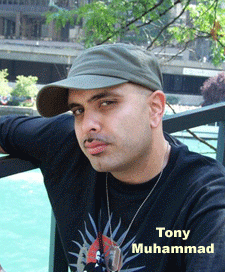
By Tony Muhammad
Hiphopeducator19@gmail.com
www.myspace.com/tonymuhammad
 In the midst of Congress attempting to pass legislation specifically to recoup $165 million in bonuses that has scandalously gone to AIG executives, the House Judiciary Committee is seeking to pass H.R. 848, the Performance Rights Act. Under this law radio stations would be required to pay royalties to artists for the music they air. According to NAB Radio Board Chairman Steve Newberry, the current economic downturn has already forced radio stations nation-wide to layoff a considerable amount of employees and reduce wages by 5 to 10 percent. He warned in his testimony to the House that if the bill is passed, it will put a whole industry “at risk.” The radio industry currently employs nearly 106,000 people but yet is on the verge of bankruptcy, reporting billions of dollars in losses every year. Newberry adds that if the bill is passed it would force many radio stations to switch to more of a “talk show” format and make them even less diverse in their play lists. Currently radio stations throughout the country, especially ones that are oriented towards “urban” and “pop” music genres are criticized for almost strictly playing from top 25 Billboard chart playlists consistently and monotonously hour to hour. Under current circumstances, local artists receive very little to no play on local stations. The passing of H.R. 848 would most certainly make matters worse.
Most interestingly and most critically, Newberry said in his testimony that “At its heart, this bill attempts to create a conflict between artists and radio stations where no conflict exists. In reality, local radio has been supporting the music industry for decades.” He continued by saying that it “boggles” his mind that “a bill that is supposed to be about benefiting artists, takes 50 percent of the performance fee and puts it into the pockets of the big four record labels, most of which are not even American companies.” These four companies are Warner Music Group, EMI, Sony and Universal Music Group.
He argues that in the end “the record labels actually walk away with more money under this bill than do the featured artists.” “The real problem, which this bill does not address,” according to Newberry, “is between the artists and these mega-record labels. Artists, often find themselves in such difficult financial straights because of the one-sided, unfair contracts they signed with their record label. If these artists had fair contracts with their labels that included fair royalty clauses, they would have benefited from the promotional value of free radio airplay that they should have enjoyed.”
After so many years (especially in the past 10) of the radio industry contributing to the problem of musical monotony in expression and form and moral degradation in the content of not just the music, but on the part of many of its “urban” on-air commentators, why is it expressing all of a sudden such a strong concern for the artists that have received the short end of the stick in the whole process? The answer is because now a threat on its very survival is being made not simply by Congress, but by the Recording Industry Association of America (RIAA) that has pushed the idea of a “need” of such a bill on behalf of the four major record labels.
Truly, the old system is destroying itself from within. These major record labels are collapsing just like the radio industry is; also reporting billions of dollars in losses every year. At this point they seek to “squeeze blood out of a turnip” in any way that they can, wherever they can find it, even if it comes at the expense of hurting relationships with websites that could aid in promoting their music and even its historic prized relationship with the radio industry. For many years the radio industry has benefited from underhanded payola (“pay for play”) deals with the recording industry. Payola deals in other words are bribes that are disguised in the form of (for example) “consulting fees” or “record pools” with radio DJs or sponsorship for the wrapping of radio station vans in exchange for the frequent playing of particular artists’ music.
Between 2005 and 2006 New York State Attorney General at the time Eliot Spitzer prosecuted payola-related crimes in his jurisdiction. Sony BMG Music Entertainment, Warner Music Group and Universal Music Group each settled out of court with Spitzer and agreed to pay $10 million, $5 million, and $12 million respectively to New York State charitable causes that work in the name of music education and appreciation programs. EMI is still under investigation for such activities. Now, if this was the case just within New York State, imagine all other places where similar activities have taken place and no investigation has ever been conducted. When pop and urban radio sounds almost the same no matter where you travel in the country, contain the same music playlists and in many cases have the same over-consumerist unintelligent expression it means that everywhere someone has been strategically sent behind the scenes to cash in on the peoples’ ignorance.
As I emphasized in PART ONE, many at times the music by-itself is not simply the product for sale; but much more so the jewelry, the apparel and the liquor emphasized in the song lyrics. Do not be surprised if the next stage of commercial-music survival will involve an adapting to brief radio announcements regarding the corporations that are sponsoring the artists showcased. It would sound something like … “And now this artist is brought to you by ….” Don’t think it can’t happen because we are increasingly and rapidly moving towards very desperate economic times. For many of us, especially in the music industry, those times are already here and they are about to get worse. Think about it! Very few artists nowadays make a substantial income on just the music alone. The most successful ones, by and large, depend on endorsement deals in order to live “lush.”
However, with the economy the way that it is, new up-coming artists and all current lime light artists that bind themselves like slaves to corporations (including the major record labels themselves) will fall just as the economy that they are so dependant on will continue to fall. In truth, the new model for artists and generally Hip Hoppers of today and of the future is (as I was discussing with artist NY Oil very recently on a phone conversation) to connect themselves with a cause – just as Wise Intelligent mentors youth in educational and music recreational programs through Intelligent Kidz and MEEN in New Jersey and Philadelphia, PA; just as the art of breaking is preserved through the efforts of Rokafella and Kwikstep of Full Circle Productions as they continuously instruct talented New York City at-risk youth to strive to reach their potential not just in the area of dance but in all aspects of life; just as Jasiri X works diligently towards establishing community justice through One Hood in Pittsburgh, PA; just as Hip Hop journalist and activist Davey D continues to expose the harsh socio-political obstacles we are all faced with byway of his own news website DaveyD.com; just as community organizer Adisa Banjoko is uprooting youth into excellence through The Hip Hop Chess Federation in the California Bay Area –
Locally we all must play our part while having a national and a global vision of unity as to what we want our future to be. As conscientious artists and Hip Hoppers in general increasingly introduce cultural arts and literacy programs in the schools, the community centers and even the juvenile detention halls, they will most certainly cause an effect in the manner the youth perceive both the world and themselves. They will begin to gravitate towards what’s real and beneficial and step by step abandon what’s artificial and detrimental to themselves and others. By putting in the necessary community-oriented work, conscientious artists and their music will naturally build a following and guarantee longevity in the support of their craft. Besides the potential world-wide success that comes with proper Internet promotion byway of ever-growing social networking outlets, the development and maintenance of local relationships is key towards establishing local success. This would entail, as the Honorable Minister Louis Farrakhan noted nearly 30 years ago at the 4th Annual Jack-The Rapper Conference in Atlanta, GA, the development of alternative music distribution centers in the community (including religious institutions) that support positive expression through music. Dependence on major music stores such as Specs and FYE is fruitless since they are also on the verge of financial collapse and do not serve to promote local and conscientious music much anyway.
By working together we can develop a new model for how a music industry should run; one that would mutually benefit communities and artists. At which point radio stations will have no other choice but to take notice and move the direction community would be moving. This is possible if we desire it to be. We must begin qualifying ourselves to be able to bring it into existence.
More to come next time through Allah’s (God’s) permission!
Tony Muhammad teaches American, African American and African History at an inner-city high school in Miami and is currently involved in efforts to reform The African American Voices Curriculum for Miami-Dade County Public Schools. Tony is most noted for his work as publisher of Urban America Newspaper (2003 – 2007) and co-organizer of the Organic Hip Hop Conference (2004 – 2008).

 We sat down with former Green Party Vice Presidential candidate Rosa Clemente to break bread about a number of issues. First and foremost we wanted to talk about the current speaking tour she is on that addresses the issue of America being a post racial society in the aftermath of the election of President Obama.
 I met Somalian born rapper Knaan about 3 or 4 years ago in his current place of residence Toronto. We chopped it up back then and he assured me that it was just a matter of time before the US Hip Hop scene would open its arms to rappers from other shores. At the time that seemed far fetched because even though we all know that Hip Hop is a worldwide phenomenon, very few heads in the states can cite more than 3 or 4 artists from neighboring Canada much less from overseas. Ask folks to name artists from Africa and the conversation is all but over…
 We talked about the make up of Knaan’s album and what it was like working with Maroon 5’s Adam Levine and Hip Hop legend Chubb Rock. He explained that Levine was a real cool and basically came through and laid down vocals for free. He just wanted to show respect and appreciation for the music.
 Modern day rap music finds its immediate roots in the toasting and dub talk over elements of reggae music. In the early 70’s, a Jamaican dj known as Kool Herc moved from Kingston to NY’s West Bronx. Here, he attempted to incorporate his Jamaican style of dj which involved reciting improvised rhymes over the dub versions of his reggae records. Unfortunately, New Yorkers weren’t into reggae at the time. Thus Kool Herc adapted his style by chanting over the instrumental or percussion sections of the day’s popular songs. Because these breaks were relatively short, he learned to extend them indefinitely by using an audio mixer and two identical records in which he continuously replaced the desired segment.
 Hip hop is the culture from which rap emerged. Initially it consisted of four main elements; graffiti art, break dancing, deejay (cuttin’ and scratching) and emceeing (rapping). Hip hop is a lifestyle with its own language, style of dress, music and mind set that is continuously evolving. Nowadays because break dancing and graffiti aren’t as prominent the words ‘rap’ and ‘hip hop’ have been used interchangeably. However it should be noted that all aspects of hip hop culture still exists. They’ve just evolved onto new levels.
 For example in August of ’67, Martin Luther King Jr addressed the Association of Television and Radio Broadcasters. Here he delivered an eloquent speech in which he let it be known that Black radio djs played an intricate part in helping keep the Civil Rights Movement alive. He noted that while television and newspapers were popular and often times more effective mediums, they rarely languaged themselves so that Black folks could relate to them. He basically said Black folks were checking for the radio as their primary source of information.
 In a recent interview hip hop pioneer Afrika Bambaataa spoke at length how NY began to lose its connection with funk music during this that time. He noted that established rock acts doing generic sounding disco tunes found a home on black radio. Acts like Rod Stewart and the Rolling Stones were cited as examples.
 Before the first rap records were put out (Fat Back Band‘s King Tem III’ and Sugar Hill Gang‘s ‘Rapper Delight’), hip hop culture had gone through several stages. By the late 70’s it seemed like many facets of hip hop would play itself out. Rap for so many people had lost its novelty. For those who were considered the best of the bunch; Afrika Bambaataa, Chief Rocker Busy Bee, Grandmaster Flash and the Furious Four (yes initially there were only 4), Grand Wizard Theodore and the Fantastic Romantic Five, Funky Four Plus One More, Crash Crew, Master Don Committee to name a few had reached a pinnacle and were looking for the next plateau. Many of these groups had moved from the ‘two turntables and a microphone stage’ of their career to what many would today consider hype routines. For example all the aforementioned groups had routines where they harmonized. At first folks would do rhymes to the tune of some popular song.