Archives for 2009

RAPPER ASHER ROTH SAYS BLACK RAPPERS TALK TOO MUCH ABOUT MONEY

dbanner1newparis

Rapper Asher Roth has  gotten himself in a LOT OF  controversy over comments posted on his Twitter blog. The white rapper supposedly, attempting to make a joke,  wrote “Been a day of rest and relaxation, sorry twitter – hanging out with nappy headed hoes.”

Who the heck is ASHER ROTH?
courtsey of playahata.com 

asherroth-225Rapper Asher Roth has  gotten himself in a LOT OF  controversy over comments posted on his Twitter blog. The white rapper supposedly, attempting to make a joke,  wrote “Been a day of rest and relaxation, sorry twitter – hanging out with nappy headed hoes.” This was around the time Roth also made another comment, “At rutgers stirring up a suckus,” hinting that the rapper made the controversial comment “hanging out with nappy headed hoes” because he may have been at Rutgers University at that time.
The rapper supposedly thought that it would be funny since he was allegedly attending Rutgers, so he blurted out the infamous words of Don Imus, the radio talk show host who was compared to that of a racist after he made the comment “nappy headed hoes” which then was targeted at mostly black female athletes, specifically the Rutgers University women’s basketball team. 
  
Since posting the comment, the rapper has been in fell retreat, he realized it was inappropriate or simply wanted to avoid any possible bashing and/or career damage as he removed the comment and allegedly made numerous attempts to apologize for his misuse or possibly offensive use of attempted humor.

Asher Roth hasn’t stopped there now he’s turning to Black men.

Apparently Asher, who’s affiliated with Atlantic Records and Jay Z and Kanye West, claims that he’s ‘disgusted’ by the Black rappers. Here’s his exact quote:

“All these black rappers — African rappers — talking about how much money they have.  ‘Do you realize what’s going on in Africa right now?'” Roth says.

“It’s just like, ‘You guys are disgusting. Talking about billions and billions of dollars you have. And spending it frivolously, when you know, the Motherland is suffering beyond belief right now.

Return to Davey D’s Hip Hop Corner

FABOLOUS LEAVES HARVARD FANS HANGING:

dbanner1newparis

Thousands attending fundraiser told to go home; rapper finally shows up over 2 hours later.

Harvard University had to cancel a concert by Fabolous after he arrived 2 1/2 hours late, causing disappointment to waiting fans and an agreement by the rapper to return the school’s deposit.      

 The rapper’s call time was 9 p.m. for the 15th Annual Eleganza Fashion Show, a fundraiser for Boston charities that work with underserved urban youth.  At 10:45, when Fab still hadn’t shown up, organizers told the 1500 fans in attendance to go on home.      

At 11:30, Fab and his crew finally arrived to an empty venue, saying his tardiness was due to a prior engagement at Brown University that ran long, according to Allhiphop.com.      

Reps for the rapper admitted to being at fault and returned half of the deposit on Saturday, while agreeing to pay the remaining balance this week.       

The annual Eleganza Fashion Show is aimed at celebrating cultural diversity on the Ivy League school’s campus.

http://www.eurweb.com/story/eur52790.cfm

Return to Davey D’s Hip Hop Corner

TIME FOR QUESTLOVE TO TAKE OVER THE JIMMY FALLON SHOW

dbanner1newparis

 Time for Questlove to take Over Jimmy Fallon Show

Maybe its me but it seems like the new crop of late night Talk show host are seriously wack. it’s high time for us to bring back Arsenio or have someone like Questlove take over….

DaveyD-questtakeovershirt

US & EUROPEAN (WHITE) NATIONS BOYCOTT UN RACISM CONFERENCE

dbanner1newparis
What credibility is there in Geneva’s all-white boycott?

What do the US, Canada, ­Australia, New Zealand, the Netherlands, Germany, Poland, Italy and Israel have in common? They are all either European or European-settler states. And they all decided to boycott this week’s UN ­conference against racism in Geneva

by Seumas Milne

The Guardian, Thursday 23 April 2009
http://www.guardian.co.uk/theguardian

What do the US, Canada, ­Australia, New Zealand, the Netherlands, Germany, Poland, Italy and Israel have in common? They are all either European or European-settler states. And they all decided to boycott this week’s UN ­conference against racism in Geneva – even before Monday’s incendiary speech by the Iranian president Mahmoud Ahmadinejad which triggered a further white-flight walkout by representatives of another 23 European states.

In international forums, it’s almost unprecedented to have such an ­undiluted racial divide of whites-versus-the-rest. And for that to happen in a global meeting called to combat racial hatred doesn’t exactly augur well for future international understanding at a time when the worst economic crisis since the war is ramping up racism and xenophobia across the world.

Didn’t Canada or Australia have anything to say about the grim condition of their indigenous people, you might wonder, or Italy and the Czech Republic about violent attacks on Roma people? Didn’t any of the boycotters have a contribution to make about the rampant Islamophobia, resurgence of anti-semitism and scapegoating of migrants in their countries over the last decade?

The dispute was mainly about Israel and western fears that the conference would be used, like its torrid predecessor in Durban at the height of the Palestinian intifada in 2001, to denounce the Jewish state and attack the west over colonialism and the slave trade. In fact, although it was the only conflict mentioned in the final Durban declaration, the reference was so mild (recognising the Palestinian right to self-determination alongside Israel’s right to security) that the then Israeli foreign minister, ­Shimon Peres, called it “an accomplishment of the first order for Israel”.

In this week’s Geneva statement, Israel isn’t mentioned at all. But the US bizarrely still used its reaffirmation of the anodyne Durban declaration to justify a boycott, to the anger of African American politicians such as Jesse Jackson and Barbara Lee, who chairs the US Congressional Black Caucus. In fact, like the other boycotting governments, the US administration had been intensely lobbied by rightwing pro-Israel groups, who had insisted long in advance that the conference would be a “hatefest”.

Ahmadinejad’s grandstanding played straight into that agenda. The most poisonous phrases in the printed version of his speech circulated by embassy officials referred to the Nazi genocide as “ambiguous and dubious” and claimed Zionist “penetration” of western society was so deep that “nothing can be done against their will”. That a head of state of a country of nearly 70 million people is still toying with Holocaust denial and European antisemitic tropes straight out of the Tsarist antisemitic forgery, The Protocols of the Elders of Zion, is not only morally repugnant and factually absurd. It’s also damaging to the Palestinian cause by association, weakens the international support Iran needs to avert the threat of attack over its nuclear programme, and bolsters Israel’s claims that it faces an existential threat.

But, perhaps as a result of an appeal by the UN secretary general Ban Ki-moon, Ahmadinejad dropped those provocations at the last minute. What in fact triggered the walkout of European Union ambassadors was his reference to Israel as a “totally racist regime”, established by the western powers who had made an “entire nation homeless under the pretext of Jewish suffering” and “in compensation for the dire consequences of racism in Europe”.

The rhetoric was certainly crude and inflammatory. Britain’s foreign secretary David Miliband called it “hate-filled”. But the truth is that throughout the Arab, Muslim and wider developing worlds, the idea that Israel is a racist state is largely uncontroversial. The day after Ahmadinejad’s appearance, the Palestinian Authority foreign minister, Riyad al-Maliki, echoed the charge in the conference hall, describing Israeli occupation as “the ugliest face of racism”. It’s really not good enough for Britain’s ambassador to the UN in Geneva, Peter Gooderham – who led the Ahmadinejad walkout – to say of the charge of Israel’s racism, “we all know it when we see it and it’s not that”.

This is a state, after all, created by European colonists, built on the ethnic cleansing of the indigenous population, whose founding legal principles guarantee the right of citizenship to any Jewish migrant from anywhere in the world, while denying that same right to Palestinians born there along with their descendants. Of course, Israel is much else besides, and the Jewish cultural and historical link with Palestine is a ­profound one.

But even those Palestinians who are Israeli citizens face what the then Israeli prime minister Ehud Olmert last year called “deliberate and ­insufferable” discrimination by a state which defines itself by ethnicity. For Palestinians in the occupied territories, ruled by Israel for most of the state’s existence, where ­ethnic segregation and extreme ­inequality is ruthlessly enforced, the situation is far worse – even without the relentless military assaults and killings. And Israel now has a far-right ­government whose foreign minister, Avigdor Lieberman, has said 90% of Israel’s Arab citizens have “no place” in the country, should be forcibly “transferred”, and only be allowed citizenship in exchange for an oath of loyalty to Israel as a Zionist Jewish state.

But if Lieberman had turned up to speak at the Geneva anti-racism conference, who believes that western delegates and ambassadors would have staged a walkout? Of course, there’s a perfectly ­reasonable argument to be had about the nature of Israel’s racism and whether it should be compared to apartheid, for example. But for western governments to hold up their hands in horror when Israel is described as a racist state has no global credibility whatever.

Israel’s supporters often complain that, whatever its faults, it is singled out for attack while the crimes of other states and conflicts are ignored. To the extent that that’s true in forums such as the UN, it’s partly because Israel is seen as the unfinished business of European colonialism, along with the Middle East conflict’s other special mix of multiple toxins. The Geneva boycotters, fresh from standing behind Israel’s carnage in Gaza, are in denial about their own racism – and their continuing role in the tragedy of the Middle East.

This article was amended on Friday 24 April 2009. We originally referred to Shimon Peres as Israel’s prime minister in 2001, he was actually the foreign minister at that time. This has been corrected.

The far-right Israeli lobby rolled up hard on President Obama and made the popular President back out of the UN Conference on Racism
Congresswoman Barbara Lee who chairs the Congressional Black Caucus was not happy when the US bounced from the racism conference

REBEL DIAZ TAKE A SERIOUS STAND AGAINST CORRUPT POWER

dbanner1newparis

  The members of The Rebel Diaz Arts Collective put together a video that was inspired by the actions of the folks of the Right to the City Coalition, by Picture the Homeless, by the NYU and New School takeovers…..

http://www.youtube.com/watch?v=iQ0P0uQRpxc

Heres the link to new video by the members of The Rebel Diaz Arts Collective. we were inspired by the actions of the folks of the Right to the City Coalition, by Picture the Homeless, by the NYU and New School takeovers…..this is our way of showing solidarity….This is our response to the conditions of our communities in New York. Mayor Bloomberg has to be held accountable for the police murders and brutality, for lack of housing, for being an investor in so much of the gentrification going on in Brooklyn, Harlem, and the South Bronx. Here is our response. Featuring: Lah Tere, G1, RodStarz, Hipnotic, Marc Bucannons, John Mega, and Yc the Cynic…..and many members of the Hunts Point community, the movement and the Rebel Diaz Arts collective…

Return to Davey D’s Hip Hop Corner

JOYNER, HARVEY & TAVIS-THE CURRENT STATE OF BLACK MEDIA

dbanner1newparis

When the Tom Joyner Morning Show was pulled first from Chicago, and then from other markets early this month, Joyner counseled listeners that “…black radio will never be what it once was, and there is absolutely nothing we can do about it.” 

Tom Joyner, Steve Harvey, Tavis Smiley, and the Impoverishment of Black Media

by BAR managing editor Bruce A. Dixon

joyner-harvey-smiley
When the Tom Joyner Morning Show was pulled first from Chicago, and then from other markets early this month, Joyner counseled listeners that “…black radio will never be what it once was, and there is absolutely nothing we can do about it.”  This message of powerlessness and permanent defeat, of resignation to someone else owning and controlling the black conversation may be all we can expect from Joyner and the rest of the black elite.  But is it the real answer? Does it even address the crucial question of how we might have and own our own black civic conversation?


Tom Joyner, Steve Harvey, Tavis Smiley, and the Impoverishment of Black Media
by BAR managing editor Bruce A. Dixon
The cancellation provoked outrage among fans because the Tom Joyner Morning Show is about as good as commercial black radio is allowed to get nowadays.”
‘The bottom line,” radio fly-jock Tom Joyner told fans in his blog, “is that black radio will never be what it once was, and there’s absolutely nothing we can do about it.” Joyner tried to put the yanking of his show by Clear Channel into perspective for fans, who deluged his blog and email with expressions of support, and even talk of consumer boycotts. Joyner discouraged boycott chatter, and like Steve Harvey, who seems likely to replace him on many Clear Channel outlets, declared it was all “just business.”
The cancellation provoked outrage among fans because the Tom Joyner Morning Show is about as good as commercial black radio is allowed to get nowadays. Despite the show’s limited playlist of corporate-approved music and periodic descents into minstrelsy, Joyner regularly sets aside a small amount of time for commentary, issues and appeals addressed to African Americans as a community. It was never much time, and the issues, the commentary were relatively safe stuff on the whole. But to the news-starved audience of black commercial radio, Tom Joyner, like his colleague Tavis Smiley, stand out like rare gulps of fresh air.
But sustaining the life of a community takes more than an occasional breath. Community and democracy demand a steady diet of news to fuel civic engagement and public conversation in the public interest.
As BAR’s Glen Ford pointed out all of six years ago in ‘Who Killed Black Radio News,” the owners of commercial black media have for a generation enforced a no-news policy, justifying it with the unsupportable claim that all black people want is to be entertained.” The fact is that news is less profitable than 100% entertainment. PR firms and the celebrity industries provide their own “news” releases complete with commercial tie-ins, and already segmented to the age and income divided groups that marketers love. Black radio owners decided not to do news because corporate media has consciously decided not to recognize African Americans as a people or a polity with our own set of collective experience and political will. In a media regime that lives and dies by advertising alone, black commercial radio will only recognize black communities as marketing contraptions, as audience segments whose ears and eyeballs it can deliver to sponsors. The owners and managers of commercial black radio and TV are not the least concerned about our past or future, our housing or health care crises, the black imprisonment rate or the digital divide or the education of our young or the dignified security of our elderly. To them we are just a market, passive consumers to be sliced and diced according to marketing industry guidelines. A hip hop station, an oldies station, an easy listening urban station, a gospel station, all under the same ownership with no news on any of them, forever and ever, amen. If this is what Joyner meant, and we think it was, when he described the current state of black commercial radio, he was right. Except the “forever’ part. Except when he told fans ‘…there’s absolutely nothing we can do about it.”
Commercial black radio and TV have not always been hostile to and incompatible with journalism. There was a brief period, back in the early and mid 1970s when journalism flourished on commercial black radio. Local teams of African American journalists competed with each other to report and package non-entertainment news directed at black communities. News gathering and reporting operations on commercial black radio played a key role in the black conversation, enabling African American communities to define themselves as more than passive masses of consumers and voters. They heyday of black broadcast journalism didn’t last long. News was never as profitable as entertainment, and as limits on how many stations one owner could have were removed, owners borrowed heavily to get more stations, and cut costs to reward themselves and repay the loans. News was the first casualty, reported Glen Ford six years ago.
There need not have been a contradiction between Black ownership and community access, including the maintenance of quality news operations. In a betrayal that, we believe, has been a major factor in the relentless decline of Black political power, many Black radio owners have adopted business plans identical to their white corporate peers.
Such is certainly the case with Radio One. “The company’s voraciousness mirrored the consolidation throughout the radio industry after rules limiting the number of stations one company could own nationally were lifted in 1996,” wrote the Washington Post, in a February 5, 2003 showcase article. Radio One boasts a 60-person research department that “randomly calls thousands of people and conducts 20-minute surveys of those who tune in to its radio stations.” Do the people want news? The subject isn’t broached by either Post reporter Krissah Williams or her main interlocutor, Radio One Chief Operating Officer Mary Catherine Sneed. Instead, the conversation is all about the sales value of entertainment programming. “If you’re not [at parties, clubs and grass-roots events], you’ll never be a big personality in the community,” Sneed said. “Those are the things that separate stations from one another.”
News isn’t even on the radar screen. Indeed, so insidiously have disc jockey patter and the talk show format been substituted for news that large segments of the Black public may no longer know the difference.
Reclaiming commercial black radio would mean rediscovering the Freedom Movement’s traditions of disrespect for illegitimate authority.”
It may be that way now, but it doesn’t have to be. Contrary to Joyner’s wisdom, there’s plenty that African American communities can do to influence the behavior of commercial black radio. But seeing the way forward, much less actually organizing it, requires thinking well outside the boxes that the black misleadership class, of which Joyner and Tavis are a part, are used to drawing for themselves and for us. Today’s black notables are too respectful of illegitimate authority, too preoccupied with their own careers, too deferential to corporate power to acknowledge the true dimensions of the crisis, or help us solve it.
Reclaiming commercial black radio would mean rediscovering the Freedom Movement’s traditions of disrespect for illegitimate authority. It would mean confronting the white and black absentee owners of corporate black radio and TV, like Clear Channel and Radio One at their own public events, like live remotes, and demanding news for the people. It would mean mobilizing people from black journalism schools and black communities to demand the reanimation of black journalism. It would mean insisting on the establishment of local news gathering operations at black radio and TV stations as a condition of the continued good will of audiences toward their owners and advertisers. That is a tall order, well outside the vision of a Tom Joyner or even of a Tavis Smiley, who sometimes pretends to be a journalist.
Leadership is seeing a way where the wise and informed tell you there is no way, and organizing people to take that way. Neither of these guys is in the leadership business. Joyner and Smiley are in the business of marketing, assembling ears and eyeballs for delivery to sponsors. In Tavis’s case, those sponsors include Wal-Mart and McDonald’s, two of the nation’s biggest and most notoriously low-wage employers, along with payday loan and housing bubble profiteers Wells Fargo and Bank of America. This seriously limits the problems one can mention on the air, let alone the solutions.
Media are the circulatory systems of modern societies. Mass media can empower us. They can enable us to carry on our conversation about what we expect from society and from each other. Or mass media can distort our public conversations and our private lives, instilling anti-cooperative and antisocial values in young and old alike. Look at BET.
African American communities are not the only ones that suffer from the slow death of journalism. Civic engagement in the larger American polity is withering too, and for the same reason. Newspapers are folding not because they are unprofitable, but because even after cutting actual journalism to the bone, they don’t bring in the fifteen and twenty percent returns that the bubble economy has accustomed investors to. A well-run newspaper can consistently bring in a seven to nine percent annual return on investment, which in pre-bubble days was considered just fine. The very few newspaper corporations that remained family owned, or that went nonprofit are doing journalism as well as ever.
Forty-some years ago, Dr. Martin Luther wondered aloud that all his life’s work might have been the integration of African Americans into a burning house. King answered his own question by declaring that if that was the case, we would have to be the firefighters, not just for ourselves, but for the whole American polity. If the demand for news, news for the people, is ever to be raised inside corporate boardrooms and in the street at live remotes, it will happen first in African American communities. Or maybe not at all. There is no legal road to this. It can only be done by confronting owners of commercial black media and making the price of a no-news regime too costly for them.
We can be firefighters, struggling for a democratic, responsible media, trying to reanimate old and configure new models of journalism for our own and the larger American community. We can disregard Joyner’s advice, and struggle to free the black conversation from corporate gatekeepers who would monetize, militarize and privatize it. Or we can burn with the rest. And watch Black Evil Television.

Share/Save/Bookmark

Straight Outta Utah: The Origins & Evolution of the Hip Hop Police

dbanner1newparis
Many have been led to believe that the survelience of rap artists by police started in New York the birthplace of Hip Hop. Ground zero is actually in Utah with a black officer who once infiltrated the Ku Klux Klan. This is an incredible story that will blow you away…

by Davey D

ronstallworth-captionMany people have long believed the first Hip Hop cop came out of New York City and recently arrived on the scene sometime after 9-11. Much of this is centered on Hip Hop’s infamous Hip Hop Task Force which was led by former NYPD detective Derek Parker. He and that task force has been the subject of several high profile news stories, a documentary and a book he authored.

The truth of the matter is that Hip Hop’s first cop is a gentleman by the name of Ron Stallworth who comes out of Utah. He’s the author of 4 books dealing with the topic of gangster rap including; 1)Gangster Rap: Music, Culture & Politics, 2)Significant Developments in Gangster Rap Music Since the Rodney King Uprising, 3)Bringin’ The Noise—Gangster Rap/Reality Rap in the Dynamics of Black Revolution, and 4)Real Niggas: Gang Bangin’ To The Gangsta Boogie in AmeriKKKa.

If that’s not enough Stallworth has testified before Congress and the Senate Judiciary Committee where he submitted some very compelling papers. Stallworth books were written when gangsta rap first started to come out of Los Angeles in the early 90s and continued to be updated to the day he retired two years ago. His books are department issued, self-publications which have been read widely by his fellow officers. They are extremely thorough, very detailed and have a keen political analysis that would actually shock most people outside of law enforcement because of some of the positions and conclusions Stallworth takes. In addition to breaking down the lyrics, street culture and gang connections behind the songs and groups Stallworth and is Utah based unit (Department of Public Safety) kept tabs on, his books gave prophetic warnings as to what would likely happen if certain police suppression based policies and practices weren’t changed or completely eradicated.
Stallworth felt that it was important his fellow officers had a clear understanding of the socio-economic and political conditions that gave rise to some of the material put out by so called gangsta rappers and Afro-centric socially conscious rappers. He let his fellow officers know why some of the rap songs being put out advocated for harm and outright killing of police.

KKK leader David Duke

In a recent interview Stallworth noted that some of his analyses did not always fit well with his brethren, but he vowed to remain objective and speak the truth. In pt1 of this 3 part interview we talked with Sergeant Stallworth about his unique background in Law Enforcement. His biggest claim to fame is how he as a brown skinned African man managed to infiltrate the Ku Klux Klan in Colorado and even be offered the position of Klan chapter leader. His Klan membership card was issued by to him personally by KKK leader David Duke.(that is shown in the picture above). His incredible police work led to the eventual dismissal of Klan members who had joined the United States Army with a couple of members actually working at NORAD. (North American Aerospace Defense Command (NORAD). This is a crazy story that in many ways eclipses his work in Hip Hop and will keep you riveted on the edge of your seat as Stallworth provides the blow by blow details. In parts 2 and 3 we talk about Stallworth work in Hip Hop.

Listen to pt 1 of  3 of this Breakdown FM Interview

http://www.swift.fm/mrdaveyd/song/72749/

————————————————————————

For the purpose of having background information here’s the story of Stallworth stint with the Ku Klux Klan

Black sergeant was ‘loyal Klansman’
By Deborah Bulkeley

About 25 years ago, Ron Stallworth was asked to lead the Ku Klux Klan chapter in Colorado Springs

Problem was, the outgoing Klan leader didn’t know that Stallworth is black.

“He asked me to take over the lead because I was a good, loyal Klansman,” said Stallworth, who had been in constant phone contact with the Klan leader while leading a yearlong Colorado Springs police investigation into the Klan.

Stallworth later moved to Utah, where he recently retired after nearly 20 years as an investigator for the Utah Department of Public Safety. He says he’s amazed that no one ever caught on to the investigation he led starting in 1979. After he was offered Klan leadership, he quietly disappeared.

As a memento Stallworth still carries his Klan membership card” signed by David Duke.

“It was one of the most fun” investigations, he said. “Everybody said it couldn’t be done.”
Stallworth communicated with Klan leaders using the telephone. A white officer posing as Stallworth went to the meetings.

“The challenge for me was to maintain the conversation flow,” Stallworth said. At the same time, Stallworth also led an undercover investigation into the Progressive Labor Party, a communist group that protested at Klan rallies.

Stallworth, of Layton, worked 30 years in law enforcement in four states. Stallworth’s undercover experience and research led him to become a nationally known expert on gang culture. He calls the Klan investigation “one of the most significant investigations I was ever involved in because of the scope and the magnitude of how it unfolded.”

The investigation revealed that Klan members were in the military, including two at NORAD who controlled the triggers for nuclear weapons.

“I was told they were being reassigned to somewhere like the North Pole or Greenland,” Stallworth said.
The Klan investigation isn’t the only time Stallworth has been mistaken for a white guy.

He’s been contacted by academics about his “scholarly research” on gangs. One such academic “said he was so impressed that a white Mormon in Utah could write such an impressive work on black gang culture.”

Stallworth said he laughed and explained that not only is he not white or Mormon, he started his college career in 1971 and remains about 2 1/2 years shy of his bachelor’s degree.

Stallworth started to work on gang activity for the Utah Department of Public Safety in the late 1980s. He wrote a report that led to the formation of Utah’s first gang task force — the Gang Narcotics Intelligence Unit that involved the Utah Division of Investigation and the Salt Lake City Police Department.

“Based on what was going on at the time, I knew about the L.A. gang problem,” he said. Utah gang suspects were “telling us they were Crips from California.”

Stallworth said of his work in Utah, it’s his investigation of gangs that he’s most proud of.
“It’s had a lasting impact, first and foremost, on law enforcement,” he said.

Wes McBride, president of the California Gang Investigators Association and retired from the Los Angeles County Sheriff’s Department, said about 15 years ago he “heard about this guy in Salt Lake who was becoming an expert” in gangsta rap music. So, he invited Stallworth to speak on the topic. It was the first of a series of lectures Stallworth gave on street-gang culture.

“I don’t know that any of us ever listened to it,” McBride said. “Where he was instrumental with us was pointing out to listen to the words, to listen to what these gangsters were saying.”

The two both testified in a 1993 homicide in which a Texas state trooper was killed by a 19-year-old gang member, McBride said. Stallworth was the expert witness on the connection between gangsta rap and gang culture in the case, McBride recalled.

Leticia Medina, executive director of Utah Issues, said she started working with Stallworth on gangs in the late 1980s, when the first Metro Gang Unit was under development. She was a youth corrections provider at the time.

“He was very interested in what my perspectives were,” she said. “I learned from him as much as I hope he learned from me.

“Law enforcement is not something that I grew up trusting. I had an opportunity to deal with a cop and see his world,” she said.

At the time, Medina said, law enforcement wasn’t involved in the community.

“They started the Metro Gang Unit, and everyone knew who the gang unit was,” she said. “One key that Ron worked on was getting to know the community and community leaders. . . . Law enforcement needed to be trained in cultural competence and gang culture.”

Stallworth has self-published four books on gang culture and has testified before Congress on gangs and violence. He also served as the state’s first gang-intelligence coordinator.

In 1994, he was selected by the U.S. Justice Department’s National Drug Intelligence centre to participate in a national street-gang symposium, the results of which were presented to the U.S. attorney general.
Now that he’s retired, Stallworth plans to remain active, politically and otherwise.

Stallworth is chairman of the Black Advisory Council and serves on Layton’s Parks and Recreation Commission and Planning Commission. He also was one of several applicants for a vacant City Council seat in Layton. Stallworth didn’t get the seat but says he plans to run for City Council.

He coaches a youth track team for 9-to-14-year-old boys and girls, and would like to volunteer for the Huntsman Cancer centre, which cared for his wife, Micki, before her death.

Stallworth is also going back to school. He wants to complete a bachelor’s degree in criminal justice administration at Columbia College.

Medina said she wouldn’t be surprised if Stallworth continues to speak up on issues close to him.
“Now that he’s retired, watch out,” Medina said. “He is very committed to all these communities. He is also very committed to the career he chose as a law-enforcement officer. . . . People need to take the time to really listen to him.”

————————————————————————

The Hip Hop Police-pt2 (Orgins & Evolution)

We continue our conversation with Sergeant Ron Stallworth who pioneered the whole Hip Hop police thing. In this podcast we speak to Ron about how and why he got involved with Hip Hop. He explained that he had no intention to become any sort of expert or to keep tabs on rappers. He’s an old school type of cat who was working in Utah department of Public Safety. One of the things this department was charged with doing was engaging the youth gangs. In the late 80s and early 90s Stallworth noted that many of the white Mormon kids started to associate themselves with Crip and Blood culture out of South Central LA and Compton and thus formed gangs. This sort of attachment puzzled Stallworth who eventually made trips to Los Angeles and teamed up with gang task force leaders to see first hand how gangs were operating and how and why they had such a hold on white kids in Utah. He eventually discovered that gangster rap via groups like NWA is how these white Mormon kids were getting their leads and cues. They were fascinated with what they concluded was ‘black culture’.

Out of necessity Stallworth had to become an expert in this new subgenre of Hip Hop. The rest they say is history. Stallworth felt it was important to truly understand the culture. He then began to see how police misconduct had fueled a lot of the rage being expressed in the songs. This led to Stallworth writing a ten page paper which contained his conclusions and observations became the basis for his first book.

In this interview Stallworth breaks down the methods he used to gather intel. He said it was all about connecting the dots and that ironically many of the rappers themselves through their lyrics and album covers which showed graffiti, street signs and other key indicators that provided all the information he and other law enforcement officials needed to paint a picture. He talks about how the biggest challenge he faced was explaining to other officers the perspective of the rappers and how and why law enforcement needed to change some of their approaches. He wanted the police to study the artists, and find common ground which he felt could lead to better relationships in the community.

He admitted that many officers were invested in maintaining a negative outlook and too often over-reacted to situations that could best be diffused with better understanding. In our interview Stallworth referenced a situation in Detroit involving NWA where plain clothes officers rushed the stage after the group attempted to perform the song ‘Fuck tha Police’. In order for Stallworth to maintain what he saw as an objective outlook he would write the books that was issued to the department on his own time and publish them with his own money and resources.

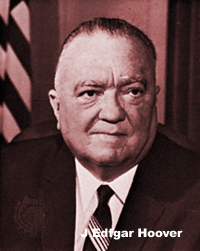
During our interview we discussed the history of surveillance in the Black community in particular Cointel-Pro. Stallworth explained in great detail how and why what he was doing was not the same as J Edgar Hoover who started the program in the late 60s.

First and foremost he felt Hoover crossed the line and violated the constitution. In fact he noted that Hoover needed to be jailed. With respect to his operation, he basically listened to the material put out by the artists and then cross referenced what they said with police resources. In other words if a rapper said he was down with gang, then Stallworth would check that out and see if it was true or not. If an artist took a picture of a street sign and put it on his album cover, he would check it out and see what the deeper significance behind it. In short many rappers were telling on themselves.

Listen to pt 2 of this Breakdown FM Interview

http://www.swift.fm/mrdaveyd/song/72750/

————————————————————————

The Hip Hop Police-pt3 (Orgins & Evolution)

“We conclude our three part conversation with retired Sergeant Ron Stallworth the original Hip Hop cop. Here we talk about the 4 books he’s written on Hip Hop Culture and Gangsta Rap. We pay particular attention to the book he wrote on Hip Hop activism. He spoke about the things he saw and heard within Hip Hop that predicted what would eventually take place during the Rodney King rebellion in 1992.

Stallworth noted that today rap music has been neutralized and has lost a lot of its urgent message. He says today kids are all about making money and that’s clearly reflected in many of the songs that are commercially viable. Says we live in a time when people want to escape poverty. We spoke about the Stop Snitching Movement. He personally finds it disgraceful; however he understands the sentiments behind it.

He says people in the community are getting the wrong message when they are being asked to tell while Congressmen remain silent when they are asked to speak out. We talked about studio gangsters. Stallworth said there are a number of rappers who say lots of things in records that don’t add up when he checked them out. He cited Snoop Dogg and Ice T as glaring examples. He also talked about the 2Pac case and Suge Knight. He said if he was running the investigation into Pac’s killing he would start with Suge. He then talked about the Death Row organization and it being a unique in the sense that it was represented by both Bloods and Crips. Lastly we talked about the music industry and the role that street gangs played and how they are perceived by law enforcement versus traditional organized crime like the Mafia. We talked about how and why the street gangs came under surveillance and why we don’t hear as much about the mob.

Listen to pt 3 of this Breakdown FM Interview

http://www.swift.fm/mrdaveyd/song/72751/

Funkmaster Flex Threatens To Ban All Interscope Artists

Imagine-Just imagine if Funkmaster Flex used his considerable influence to play any number of socially conscious artists who have something meaningful to say? Imagine if he got on the air and threatned not to play any artist who wasn’t talking about the War in iraq or police brutality? Imagine if Flex threatened not to play any artist who had disparging words about women? mmmmmmm

Davey D

Funkmaster Flex Threatens To Ban All Interscope Artists

April 22nd, 2009 | Author: Danielle Harling,

New York deejay Funkmaster Flex made a sizable threat on his HOT97 radio show. According to Flex, he plans on banning all Interscope artists from his show.

Throughout the broadcast, Flex made several references to an employee at Interscope Records whom he referred to as Nino.

“Like I told you, Interscope Records is a label,” Funkmaster Flex explained on his show. “They have G-Unit—they have 50 Cent, Lloyd Banks, Tony Yayo. They have Akon’s label too…A lot of your favorite artists New York, but let me tell you something. That label is trying to make some decisions. Nino, let me tell you something Nino. New York, I’m talking to a person who makes decisions. Who does things up there moving funny style.”

Flex then went on to explain that he will no longer play any music from artists on Interscope unless changes are made.

“Interscope Records, nothing is spinning…I take pride in how I’m gonna do this movement,” Flex explained.

Flex even urged 50 Cent to leave the label telling the Queens rapper, “From what I understand your deal’s up at Interscope. We got you. I’d walk out that building after that. Let’s do it, let’s do it.”

If Flex’s boycott were to in fact happen, major artists such as Eminem and Dr. Dre will no longer be in Flex’s rotation.

One Night in Frisco-DJ Rhettmatic vs Eric Bobo of Cypress Hill

One Night in Frisco pt1-Meeting of the Minds

Last night (April 20th) in San Francisco two legends squared off –DJ Rhettmatic of the Beat Junkies and drummer Eric Bobo of Cypress Hill.. The pair traded percussion blows to an amazed and excited crowd who described the encounter as Hip Hop reborn..The energy was off the hook and we caught some of it on tape.. Enjoy and spread the word


One Night in Frisco pt2-Five Minutes of Funk

DJ Rhettmatic  of the Beat Junkies vs drummer Eric Bobo of Cypress Hill

We continue our musical journey in pt2 w/ DJ Rhettmatic and drummer Eric Bobo of Cypress Hill..The two Hip Hop legends went head to head the other night in San Francisco.. This is 5 minutes of dopeness. No talking, just music.. enjoy

The Creativity Stimulus

dbanner1newparis


THE CREATIVITY STIMULUS
By Jeff Chang
jeffchangplad225On inauguration day, Tom Brokaw was moved to compare Barack Obama‘s election to Czechoslovakia’s 1989 Velvet Revolution. At the eye of each storm, of course, was an icon who merged the political and the aesthetic–Václav Havel, the rock-star poet and prophet, and Barack Obama, the post-soul master of his own story. Both struck down eras of monocultural repression with their pens.

Artists played a largely unheralded role in Obama’s victory. But they had been tugging the national unconscious forward for decades, from the multiculturalist avant-gardes of the 1970s and ’80s to the hip-hop rebels of the ’90s and 2000s, plying a fearless, sometimes even unruly kind of polyculturalism. By the final months of the election season, these artists had secured Obama as the waking image of change.

Every moment of major social change requires a collective leap of imagination. Political transformation must be accompanied not just by spontaneous and organized expressions of unrest and risk but by an explosion of mass creativity. Little wonder that two of the most maligned jobs during the forty years after Richard Nixon’s 1968 election sealed the backlash of the “silent majority” were community organizer and artist.

Obama was both. So why haven’t community organizers and artists been offered a greater role in the national recovery?

During the transition, arts advocates floated some big ideas–including the creation of an arts corps to bring young artists into underfunded schools, the expansion of unemployment support and job retraining to people working in creative industries and the appointment of a senior-level “arts czar” in the administration. But in practice, they faced the wreckage left by a nearly three-decade culture war.

In January they lobbied for $50 million for the NEA in the stimulus package and prevailed over Republican opposition. The one-time allocation will preserve more than 14,000 jobs, allow for new stimulus grants and leverage hundreds of millions more in private support for the arts. Two million Americans list “artist” as their primary occupation. Nearly 6 million workers are employed in the nonprofit arts-and-culture complex. In the words of the NEA’s Patrice Walker Powell, the stimulus vote finally “dignified [them] as part of the American workforce.”

The victory reflects how notions of the value of creativity have changed. During the past decade, discussions advanced beyond the dead-end debates about the limits of government-funded free expression. Boom-era theorists like Richard Florida and Elizabeth Currid, not to mention Hollywood bulls like Darren Star (Sex and the City) and Doug Ellin (Entourage), helped make creatives sexy again. Groups like the US Conference of Mayors dreamed not just of expanding cultural tourism or fostering postindustrial innovation but of attracting new chai latte-sipping bourgeois into decaying parts of town. The economic value of creativity was so firmly established by the mid-’90s that it helped drive the ravenous appetite for global corporate consolidation once the Clinton administration began sweeping aside ownership caps and deregulating markets.

For decades, the de facto policy has been to confuse the culture industry with the source of creativity and largely to abandon the production, promotion, distribution and enjoyment of arts and culture to the dictates of the boom/bust marketplace. The result has been the spread of “lifestyle economies” that are merely new forms of monoculturalism and the rise of an environment increasingly antithetical to creativity. A wave of deregulation in the culture industry has consolidated distribution channels and destroyed local scenes, locked away sources of inspiration behind fences of “rights management” and copyright and favored a “blockbuster or die” approach that raises barriers to entry and creates diseconomies of scale. Call it the privatization of the imagination.

So it is important to restate the case for public funding of culture. President Obama recently signed into law a $155 million budget for the NEA. He has also created a White House position on culture and the arts and has tapped Kareem Dale, a Chicago lawyer who worked on his campaign. Some advocates believe this may signal an executive shift away from a culture-war footing and toward a higher level of presidential engagement in creativity policy.

Still, Dale will be no arts czar. Along with his arts and culture duties he will be juggling responsibilities regarding disability policy previously assigned by the president. And the NEA funding is still less than New Zealand’s culture budget. Even adding in a $155 million allocation to the National Endowment for the Humanities, we still have nothing resembling a national commitment to creativity.

What we might call “the creativity stimulus” goes far beyond job creation and even economic development. Culture is not just something conservatives wage war on. The arts are not just something liberals dress up for on weekends. Creativity can be a powerful form of organizing communities from the bottom up. The economic crisis gives us a chance to rethink the role of creativity in making a vibrant economy and civil society. Artists as well as community organizers cultivate new forms of knowledge and consciousness. One of the unsung stories of the past twenty-five years is how both have used creativity to inspire community development and renewal. Creativity has become the glue of social cohesion in times of turmoil.

In Detroit the James and Grace Lee Boggs Center to Nurture Community Leadership, built around the inimitable 93-year-old woman who gives the center its name, has served as a home for some of the city’s sharpest young organizers and artists, in its Detroit Summer program. One of them, the acclaimed rapper Invincible, has produced an eleven-minute video for her song “Locusts.” It serves not just as a fine documentary of the center’s work against gentrification and displacement or a profound meditation on the Motortown’s past but also as a defiant middle finger in the face of pessimists like Florida, who all but wrote off Detroit in a recent Atlantic Monthly cover story.

Obama’s green-jobs-for-youth proposal emerged first from Oakland’s Ella Baker Center for Human Rights, where staffers tried to figure out how to make the environmental movement pay attention to the hip-hop youths coming into the center. On the other side of Oakland, the Eastside Arts Alliance helped revitalize the troubled city’s International District by serving as a haven for socially conscious artists, organizers and intellectuals, bringing together leaders of the Black Arts Movement with those of the hip-hop movement.

Deeply rooted in the communities that made Obama’s victory possible, these centers understand their work as transformational. Their communities are the most vulnerable to assaults on creativity, but they are also incubators of the most innovative ideas and movements of our time. This “creative communities” approach has created a vigorous and vital alternative to neoliberal and neoconservative versions of change.

Cross-generational dialogues have begun between older activists inspired by the examples of 1930s WPA arts projects and 1970s CETA cultural development programs and the post-NEA-meltdown do-it-yourselfers raised on the independent ethics and aesthetics of hip-hop and punk. Such discussions could help shape a framework for a cultural policy that focuses on the de-monopolization and reregulation of the culture industry, preserves national arts legacies, restores and upholds localism, aligns corporate interests with individual expression, promotes a radical spirit of diversity and unshackles creativity to rebuild communities and the national economy.

A creativity stimulus policy might follow the example of the distinguished tenure of Brazil’s former culture minister, Gilberto Gil. The famed musician’s art collided with the repressive dictatorship, and he was temporarily exiled in the late ’60s. More recently, his desire to rerelease three of his most famous songs under a Creative Commons license–songs he said celebrated “the idea of the permanent transformation of everything that exists, of the uninterrupted remaking that produces culture, life and the world”–was thwarted by the publisher and owner of his songs, Warner/Chappell Music.

In 2003, in his first speech as culture minister, Gil stated that he wanted to forge “the opening of territory for creativity and new popular languages,” ensure “the availability of space for adventure and daring” and secure “the space of memory and invention.” Our urgent task is not just to repair the present but to recover the past and sow the future. When we are committed to advancing creativity, we will free these trailblazers to write the new narratives of America.